Banyana Banyana secured qualification for the 2027 FIFA Women’s World Cup through the positional play-offs, after a hard-fought 2-1 victory over Nigeria on Thursday evening at Moulay Rachid Stadium in Casablanca, Morocco.
Goals from Thembi Kgatlana and Refiloe Jane were enough to book South Afri...
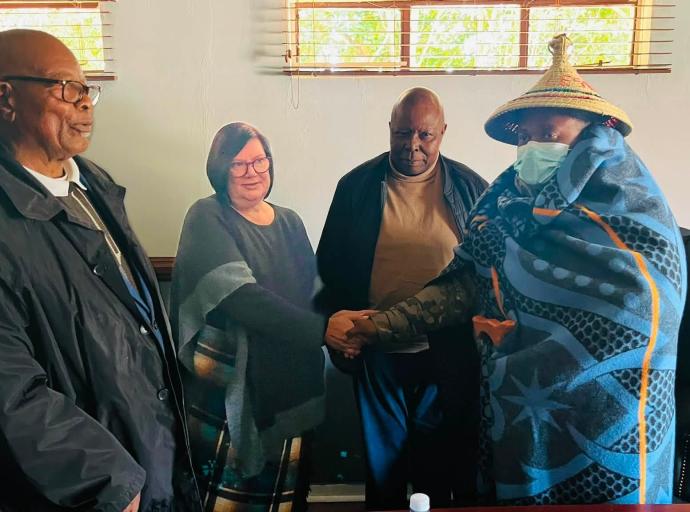
The Free State MEC for Agriculture, Rural Development and Environmental Affairs (DARDEA), Elsabe Rockman, has unveiled an ambitious strategy to strengthen food security, combat Foot-and-Mouth Disease (FMD) and transform emerging farmers into commercial producers during a high-level engagement with local farmers and traditional leaders in Namahadi.
The strategic meeting, held at the Bakoena Royal Council, focused on tackling immediate agricultural challenges while laying the foundation for sustainable rural economic growth.
A key priority was the province's aggressive response to the Foot-and-Mouth Disease outbreak. The Department has already administered more than one million vaccinations towards its target of three million, with four vaccination rounds completed in QwaQwa and three in Harrismith.
MEC Rockman called for stronger collaboration between government, farmers and traditional leaders to contain the disease while expanding farmer support through initiatives such as veld fire-fighting and rescue training.
Traditional leadership, led by Morena e Moholo Moremoholo Motebang Mopeli, raised concerns over historical land constraints that have left many communities farming on fragmented pieces of land, limiting agricultural productivity and economic growth.
To stimulate rural development and reduce dependence on social grants, traditional leaders requested government support for communal tractors, seeds, farming equipment, communal kraals, cattle handling facilities, additional livestock pounds and fencing around agricultural villages to combat escalating stock theft. They also appealed to Executive Mayor Cllr Tumelo Thebe to lease farms to traditional councils to establish community farming cooperatives.
Responding to these requests, MEC Rockman committed to developing a joint implementation roadmap with local and district municipalities to ensure measurable and sustainable outcomes.
"The Department will establish a dedicated workstream—with terms of reference formulated to guide cooperation and coordination—and this process will be led by DARDEA's legal team," she said.
The partnership will include testing approximately 100 hectares of arable land to determine crop suitability while expanding skills development programmes for local farmers.
Rockman further urged farmers to diversify beyond livestock production by investing in poultry, piggery and climate-suited crop farming, while positioning local producers to access commercial markets through major retailers including Pick n Pay, Spar and Shoprite.
As part of its long-term environmental and food security strategy, the Department also announced plans to plant one million trees over the next five years and intensify efforts to attract young people into agriculture, positioning the sector as a driver of jobs, entrepreneurship and economic growth in the Free State.
Earlier this week, the Northern Cape Premier Zamani Saul tabled a R324.794 million budget for the Office of the Premier at the Galeshewe community hall.
Saul says in the 2026/27 financial year, the province will prioritise governance, service delivery, skills development and municipal support.
Focus on Sol Plaatje and Kimberley revival.
Saul highlighted progress in Sol Plaatje Local Municipality and said that the provincial government was working closely with the council to improve stability and service delivery within the municipality.
He said the municipality’s seven-year, R2.5 billion upgrade at the Riverton Water Treatment Works was making significant progress.
“Today we can proudly pronounce that daily and nightly water shutdowns are a thing of the past.
“Water quality has drastically improved, and water leakages have been considerably reduced.
“The project is expected to secure clean drinking water for the next 50 years, create 442 local jobs and support nearly 50 small businesses.
“The municipality is also at an advanced stage of securing funding to upgrade sanitation infrastructure to address sewer spills, he said.
Saul also said the government was repairing potholes, cleaning the city and rolling out youth skills programmes to restore Kimberley’s status as the provincial capital.
“The government remains committed to diversifying Kimberley’s economy by transforming it from a former mining town into a university town,” he said.
“As part of that push, events under the Diamonds and Dorings brand have been introduced, including the Jazz Festival, ABSA Wildeklawer Sports Tournament, Yonder Hartsfees, Kimberley Big Hole Marathon and Kimberley Diamond Cup.
“These events are aimed at positioning Kimberley as a major tourism and events destination of choice,” Saul said.
Governance and frontline monitoring
Saul said the Office of the Premier continues to coordinate provincial programmes and monitor implementation.
“Four priority areas were identified this year, and that is to improve healthcare, to accelerate agricultural and rural development, to speed up housing delivery, and to strengthen infrastructure.
“Monitoring teams have already inspected 40 health facilities province-wide and recommendations from those inspections are being implemented, said Saul.
He revealed that to strengthen healthcare, 31 support workers who include cleaners, food aides, laundry aides, porters and mortuary attendants have been appointed at 11 flagship facilities and said a second phase to fill 41 additional posts is underway, with appointments set for 1 August this year.
“The Department of Health has been instructed to finalise improvement plans for facilities, with progress tracked through the province’s integrated monitoring and evaluation system, he said.
Skills and budget cuts
“Despite a 26% budget cut compared to the previous year, the office of the premier will continue to deliver.
“We continue to employ innovative means to remain of service to the people of the Northern Cape.
“ Every rand appropriated must reflect value for money and produce measurable outcomes,” he said.
Through partnerships with SETAs, the says the province has supported 383 artisans, 2212 learnerships, 990 internships, more than 3,200 participants in skills programmes, 862 bursaries and 611 work-integrated learning opportunities.
“A new R137 million partnership with the Services SETA will benefit 1662 young people and provide internships for 1,000 unemployed graduates.
“The province also awarded R14.4 million in bursaries to 259 students for the 2026 academic year.
“Thirty-six beneficiaries graduated during autumn ceremonies, he said.
Institutional and gender priorities
Saul says his department has approved a revised organisational structure to strengthen governance and capacity and that priority will be given to filling strategic posts to improve policy coordination and performance management.
“All departments will be required to integrate gender-responsive planning and budgeting. The Provincial Women’s Economic Council will continue driving women’s economic empowerment, he said.
Saul reaffirmed his commitment to the Provincial Sanitary Dignity Programme and to combating gender-based violence through coordinated interventions.
“The province’s Operation Clean Audit initiative remains on track, with the government aiming for clean audits across all departments, added Saul.
The race to become the next Executive Mayor of Free State’s only metro municipality, Mangaung, has officially begun, with seven candidates appearing before an ANC interview panel this week at Luthuli House in Johannesburg.
Among those vying for the influential position is incumbent Mayor Gregory Nthatisi, as the governing party moves to fill one of the country's most politically significant municipal leadership posts amid growing pressure to restore stability, improve service delivery, and rebuild public confidence in the metro.
The interviews form part of the ANC's internal selection process to identify a preferred candidate – with leadership credentials, governance experience, and ability to steer the troubled municipality out of its prolonged political and service delivery challenges – to be recommended for election by the Mangaung Metro Council post November 4 local government elections.
With the contest shaping up as a high-stakes political battle, Nthatisi faces stiff competition from former ANC Free State Deputy Chairperson and former Mangaung Executive Mayor Thabo Manyoni, as well as former Free State Finance MEC Gadija Brown, among other contenders.
The race is being closely watched by ANC structures, councillors, and residents, with the outcome expected to have far-reaching implications for the future of the metro.
According to a source within the ANC's regional structures, Nthatisi, Manyoni, and Brown are widely regarded as the leading contenders and are considered strong candidates not only for the mayoral position but also for the metro's top political leadership.
"If you look at the shortlisted candidates, although the process is still at an early stage, these three comrades have the experience, leadership credentials, and political standing required to lead the municipality," said a party insider.
"The frontrunner is likely to become mayor, while the second and third-ranked candidates could be considered for the positions of deputy mayor and speaker, respectively," the source added.
Other candidates include current ANC Regional Chairperson and Mangaung Speaker Lawrence Mathae, Regional Deputy Chairperson Vusi Soqaga, Member of the Mayoral Committee (MMC) for Integrated Development Plan and Performance Theodorah (Theo) Mosala, and Deputy Mayor Lulama Titi Odili who recently made headlines following the arrest of her Nigerian husband, Lyndon Adentuji Odili, commonly known as Eric. He is facing 18 counts of allegedly harbouring, aiding, abetting, assisting or enabling undocumented foreign nationals to remain in South Africa in contravention of the country's immigration laws.
Meanwhile, speaking to Journal News on Thursday, incumbent Executive Mayor Nthatisi expressed confidence that he will retain the mayoral office following the November local government elections.
He said he believes he has earned the trust of Mangaung residents through his hands-on leadership and direct engagement with communities.
"All I can tell you is that I've built a sound relationship with people across the metro. I enjoy serving them, and I believe they have come to know me because I have made myself accessible and exposed myself to the challenges they face. Otherwise, they wouldn't have known me," he said.
Nthatisi was appointed Executive Mayor of Mangaung in 2023, following a resignation of the former mayor Mxolisi Siyonzana who had a fallout with the regional structure.
A veteran anti-apartheid activist and former Umkhonto we Sizwe (MK) combatant, he has had a long political career spanning the liberation struggle. In 2020, he served as Secretary-General of the MK Council.
It is a bitterly cold Friday morning in Botshabelo. The kind of Free State cold that makes even someone who never studied geography suddenly appreciate the value of cuddling. But the freezing weather has not kept people indoors.
The Botshabelo Arena is already overflowing with life. Elderly people wrapped in blankets, mothers carrying babies, young people clutching folders filled with documents and workers hoping to sort out their affairs before the day slips away. They have all come for the government services they deserve.
The Premier of the Free State, Hon. MaQueen Letsoha-Mathae, is walking among the people. Not waving from a stage but moving from queue to queue, speaking to residents, checking on officials and making sure government is doing what it is supposed to do. That image for me says more than a hundred speeches ever could.
Just a few days earlier, social media was buzzing with frustration. Residents posted pictures and videos of painfully long queues at SASSA offices in Botshabelo. The complaints were impossible to miss. Pensioners waited for hours. People stood in the cold from the crack of dawn. The anger was real because the suffering was real.
Many politicians have mastered the art of pretending not to see. They become experts in silence, hoping tomorrow's scandal will bury today's embarrassment. It is almost a universally agreeable tradition. But this time was definitely different. The Premier did something particularly refreshing; she simply moved government.
Within days, departments from across government were brought together in Botshabelo. Services that normally require people to spend days moving from one office to another were brought under one roof. Instead of making citizens to chase government, government was made to come to the people. That is exactly how it should be.
For too long we have normalised that poor people must suffer twice. First, they struggle with unemployment, poverty and rising costs. Then they must spend money they do not have on transport, stand in endless queues and return home without being helped because the system has closed for the day.
Somewhere along the line, as government officials, we started behaving as if this was normal and it is not. The state exists to serve the people, not the other way around.
The Premier has reminded us of something we should never have forgotten. Leadership is not measured by how many press statements are issued, but by how quickly we respond when our people cry out. That response matters.
When government listens, our people notice. When government acts quickly, people begin to believe that their voices carry weight. That confidence is precious because it cannot be bought. It must be earned.
I am in no way pretending that two days of integrated service delivery will resolve every problem facing Botshabelo and the Free State as a whole. Our people still need jobs. Roads still need fixing. Water systems still need attention. Our municipalities still have very tall mountains to climb.
But leadership is revealed in moments like these. A complaint appears on Monday. Government is on the ground before the week is over. That sends a powerful message that we have a government that listens.
Imagine if every sphere of government worked with that kind of urgency. Imagine if every MEC, every mayor and every senior official treated public frustration as a call to action instead of a public relations headache. We would spend less time explaining service delivery failures and more time delivering services.
The people of Botshabelo deserved to be heard. More importantly, they deserved to be helped. On this cold Friday, they witnessed government at work. That is the leadership the Free State needs. A leadership that does not wait for protests before acting.
A leadership that understands that every queue is made up of human beings, not statistics. A leadership that knows the shortest distance between government and the people is not another meeting but showing up.
Tshediso Mangope moonlights as a social and political commentator in his spare time...
Thousands of residents lined the streets of Bethlehem on Monday, 6 July 2026, as Bafana Bafana and Mamelodi Sundowns midfielder Teboho Mokoena received a heartfelt hero’s welcome in his hometown following his exploits on the international stage.
The celebrations were part of a homecoming programmes organised to honour one of the most celebrated sporting figures from the Eastern Free State, whose achievements continue to inspire aspiring footballers across the Thabo Mofutsanyana District.
Following his official welcome, Mokoena visited Bohlokong New Hall, where he was greeted by jubilant supporters, residents and football enthusiasts. The energy was electric as songs, cheers and applause echoed through the venue, with community members proudly celebrating one of their own.
The celebrations then went to Boiketlong Hall, where another enthusiastic crowd gathered to recognise Mokoena’s remarkable football journey and applaud his continued success both for Bafana Bafana and Mamelodi Sundowns.
The day’s programme ended at Dihlabeng Mall, where Mokoena spent time interacting with supporters, posing for photographs and expressing his appreciation to the community that has supported him throughout his career.
Reflecting on the emotional reception, Mokoena said that the overwhelming support exceeded anything he had imagined growing up.
“I feel privileged. I feel proud. I am excited to see, especially now, my community here to celebrate me and welcome me back home. It is such an awesome feeling. I never thought as a kid I would be here and experiencing such an atmosphere.
“I have been to three places, and I have received so much love from the community of Bethlehem. I am so excited and I can only say thank you to everyone who has been there for me, giving me the support,” said Mokoena.
The Thabo Mofutsanyana District Sports Confederation attended the celebrations in a full capacity, marking the occasion as a historic moment for the region. Sports administrators and stakeholders from across the district joined community members in celebrating Mokoena’s achievements and recognising the impact he has made on South African football.
SAFA Thabo Mofutsanyana Regional President, Elizabeth de Koker, praised Mokoena not only for his performances on the field but also for the positive values he continues to promote among young people.
“We are very thankful for what he has done for the community, using football as a vehicle to inspire a lot of young people.
“What I like today is that he has emphasised respect, encouraging young people to respect others and keep themselves busy with things that matter, especially sport,” De Koker said.
Dihlabeng Executive Mayor, Tseki Tseki, also commended Mokoena’s commitment to giving back to his hometown, highlighting the football activities he has organised with local schools.
“Teboho is having some of the games that he has organised with schools within the municipality. We are part of the stakeholders working with him to ensure that he continues to plough back into the community while promoting sport throughout the area,” said Tseki.




_thumbnail.jpg)

