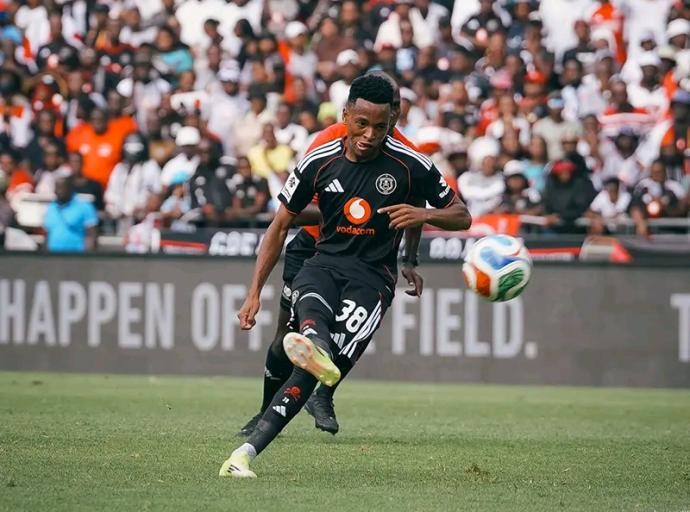
Banyana Banyana secured qualification for the 2027 FIFA Women’s World Cup through the positional play-offs, after a hard-fought 2-1 victory over Nigeria on Thursday evening at Moulay Rachid Stadium in Casablanca, Morocco.
Goals from Thembi Kgatlana and Refiloe Jane were enough to book South Afri...
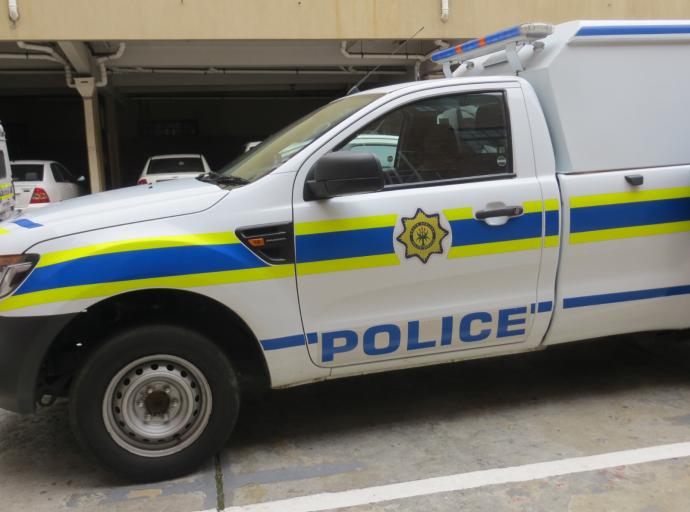
The South African Police Service (SAPS) in Brits has launched an investigation into a case of attempted murder following the shooting of Madibeng Municipal Manager (MM) Quiet Kgatlha.
Kgatlha escaped an apparent assassination attempt after his car was shot at multiple times on Wednesday while travelling on the Zilkaatsnek Road towards Hartbeespoort Dam in the evening.
“It is alleged that a charcoal-coloured VW Polo TSI with Gauteng registration plates overtook his vehicle and two unidentified male occupants allegedly opened fire on the vehicle, discharging multiple rounds before fleeing the scene,” said Colonel Adele Myburgh.
Authorities said even though he sustained two gunshot wounds, he managed to control the car and drive to safety.
“The victim sustained two gunshot wounds, one to his leg and another to his arm. Despite his injuries, he managed to maintain control of his vehicle before coming to a stop near a petrol service station at Zilkaatsnek.”
Myburgh added that emergency medical personnel responded to the scene and, despite the sheer volume of gunfire unleashed on him, Kgatlha miraculously survived,d and he was transported to a local hospital for medical treatment, where he is still admitted in a stable condition.
The authorities said the motive for the attack remains unknown and forms part of the ongoing investigation.
Kgatla was suspended last year for alleged financial misconduct in a housing contract; however, the High Court later overturned his suspension as it had expired before any action was taken and he was reinstated.
Bafana Bafana coach Hugo Broos has cautioned eager supporters to temper their expectations regarding Relebohile Mofokeng’s European move.
The national mentor warned that the 20-year-old winger faces a gruelling physical adaptation period upon joining Belgian side Royale Union Saint-Gilloise.
Broos emphasised that the Belgian Pro League demands immense power and intensity that the young star does not yet possess.
He expects the club to focus heavily on building the youngster's fitness during his first half-year abroad.
“I also think that you do not have to expect that from the first day he will play because Rele has to be stronger. It is a very tough competition in Belgium. So I think the first five or six months they will put him in fitness to get a little bit stronger,” Broos explained.
Despite the reality check, the experienced coach remains entirely supportive of the transfer to his home country.
He believes this step is exactly how South Africa’s brightest talents must organise their progression into elite football.
“I think it is a good thing for him. I think he will progress,” Broos said.
The endorsement follows confirmation from Orlando Pirates that a transfer agreement has been reached with the Belgian outfit.
The move remains subject to the finalisation of personal terms and a successful medical examination.
Meanwhile, the Soweto giants revealed that the deal was intentionally kept quiet until after the FIFA World Cup to protect the player's focus.
“An agreement in principle between Orlando Pirates and Union Saint-Gilloise was in fact reached before the start of the FIFA World Cup.
“Both parties made the joint decision to hold off on any public announcement until after the tournament, wanting Mofokeng to focus fully on the World Cup with Bafana Bafana without the distraction of transfer talk, and to allow the national team’s historic run to take centre stage,” the club’s statement read.
Bafana Bafana coach Hugo Broos has cautioned eager supporters to temper their expectations regarding Relebohile Mofokeng’s European move.
The national mentor warned that the 20-year-old winger faces a gruelling physical adaptation period upon joining Belgian side Royale Union Saint-Gilloise.
Broos emphasised that the Belgian Pro League demands immense power and intensity that the young star does not yet possess.
He expects the club to focus heavily on building the youngster's fitness during his first half-year abroad.
“I also think that you do not have to expect that from the first day he will play because Rele has to be stronger. It is a very tough competition in Belgium. So I think the first five or six months they will put him in fitness to get a little bit stronger,” Broos explained.
Despite the reality check, the experienced coach remains entirely supportive of the transfer to his home country.
He believes this step is exactly how South Africa’s brightest talents must organise their progression into elite football.
“I think it is a good thing for him. I think he will progress,” Broos said.
The endorsement follows confirmation from Orlando Pirates that a transfer agreement has been reached with the Belgian outfit.
The move remains subject to the finalisation of personal terms and a successful medical examination.
Meanwhile, the Soweto giants revealed that the deal was intentionally kept quiet until after the FIFA World Cup to protect the player's focus.
“An agreement in principle between Orlando Pirates and Union Saint-Gilloise was in fact reached before the start of the FIFA World Cup.
“Both parties made the joint decision to hold off on any public announcement until after the tournament, wanting Mofokeng to focus fully on the World Cup with Bafana Bafana without the distraction of transfer talk, and to allow the national team’s historic run to take centre stage,” the club’s statement read.
One of history's great mysteries that scientists are yet to research is the relationship between an empty fridge and ideological flexibility. Marx wrote about class. Fanon wrote about decolonisation. Biko wrote about psychological liberation. But none of them adequately prepared us for the political migration that occurs when the butter disappears and the electricity bill remains unpaid.
Andile Mngxitama deserves his own chapter in political science. There was a time when Mngxitama spoke as though Steve Biko had left him (alone) the spare key to Black Consciousness.
His every sentence carried the cadence of liberation, every paragraph smelled of Azanian possibility, and every critic was dismissed as suffering from terminal colonial consciousness. If you listened carefully enough, you could almost believe Biko had appointed a deputy before leaving this world. Then something extraordinarily horrible happened. The refrigerator began making political decisions.
When Julius Malema led the ANC Youth League, Mngxitama templated him a betrayer of the revolution who was merely holding a toy gun. Then, as if guided by an invisible GPS calibrated to the nearest source of survival, his destination suddenly became the EFF. It would seem some bridges are not burned, they merely require a catering budget.
Then came Jacob Zuma.
There was a period when Zuma represented everything wrong with the post-apartheid political establishment. Mngxitama would shout his lungs out from Malema’s spaza shop in parliament demanding Zuma to go and his criticism of Zuma flowed freely. But then the vocabulary changed, the tone changed too. Even the thieving and corrupt Indian Gupta family, in whose pockets Zuma dwelled, became tall revolutionary heroes. Black consciousness appeared to undergo a miraculous software update. Once again the fridge had entered the conversation and black consciousness principles reached an expiry date.
Now comes another fascinating chapter.
The man who once preached uncompromising Black unity, now supports the “march and march” advance merely because his breadwinner from Nkandla supports it. Vice Biko increasingly finds himself echoing positions that would have drawn fierce criticism from his earlier Black Consciousness self. The Andile of yesterday would probably have written blistering articles condemning the Andile of today as surrendering to reactionary politics.
The Andile of today would undoubtedly reply that the Andile of yesterday lacked revolutionary maturity. It is difficult to determine which Andile would win the debate, although both would insist they represent the authentic tradition of Black Consciousness.
This is not unique to Mngxitama. It has become a recurring disease in our politics.
The loudest guardians of principle often become the fastest auctioneers of principle once survival demands a new vocabulary. Suddenly ideology becomes strategy and contradiction becomes tactical repositioning. Language is endlessly inventive when their livelihoods are involved.
The greatest tragedy is not that Mngxitama always changes his mind. Human beings evolve. Circumstances change. Evidence changes. Honest reflection is a virtue. The tragedy is that each time he pretends that every u-turn was always a straight line.
One year he is quoting Steve Biko to denounce everyone else. The next year he is explaining why his latest alliance with same people is the inevitable culmination of Biko's unfinished project. Somehow Biko always ends up endorsing whichever organisation currently provides him the microphone. It is almost miraculous.
Science teaches us that tadpoles grow into frogs. That is evolution. But science can never successfully explain how a fully grown frog can wake up one morning and become a tadpole. Yet Mngxitama’s politics specialises in precisely this miracle. He claims ideological adulthood today and suddenly returns to the political nursery when circumstances require a fresh beginning. They call it reinvention. Perhaps we should stop asking him whether he has principles. The better question is whether those principles can survive grocery shopping.
History suggests that when the cupboard is full, conviction speaks loudly. But when the cupboard is empty, the same conviction suddenly discovers coalition politics. And somewhere, Steve Biko must surely be wondering why his name is forever being expropriated by someone who return it only after he has secured the next political meal.
On thing is certain though, the refrigerator and political consciousness are mutually reinforcing in Mngxitama’s world.
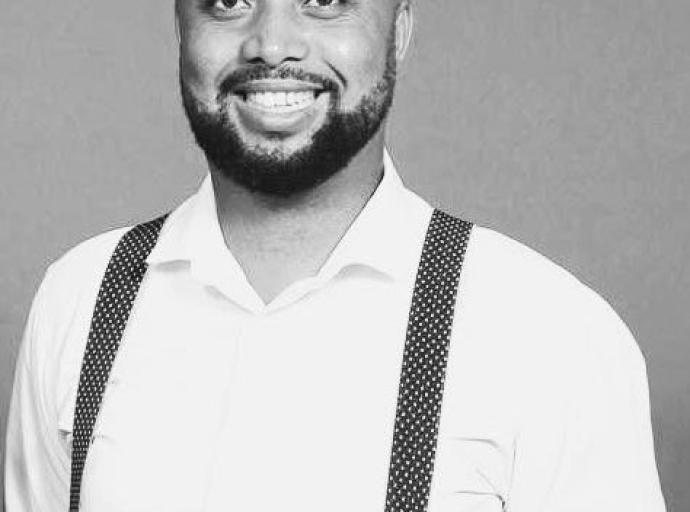
Tshediso Mangope moonlights as a social and political commentator in his spare time…
*The views expressed do not necessarily reflect those of this publication (Journal News).
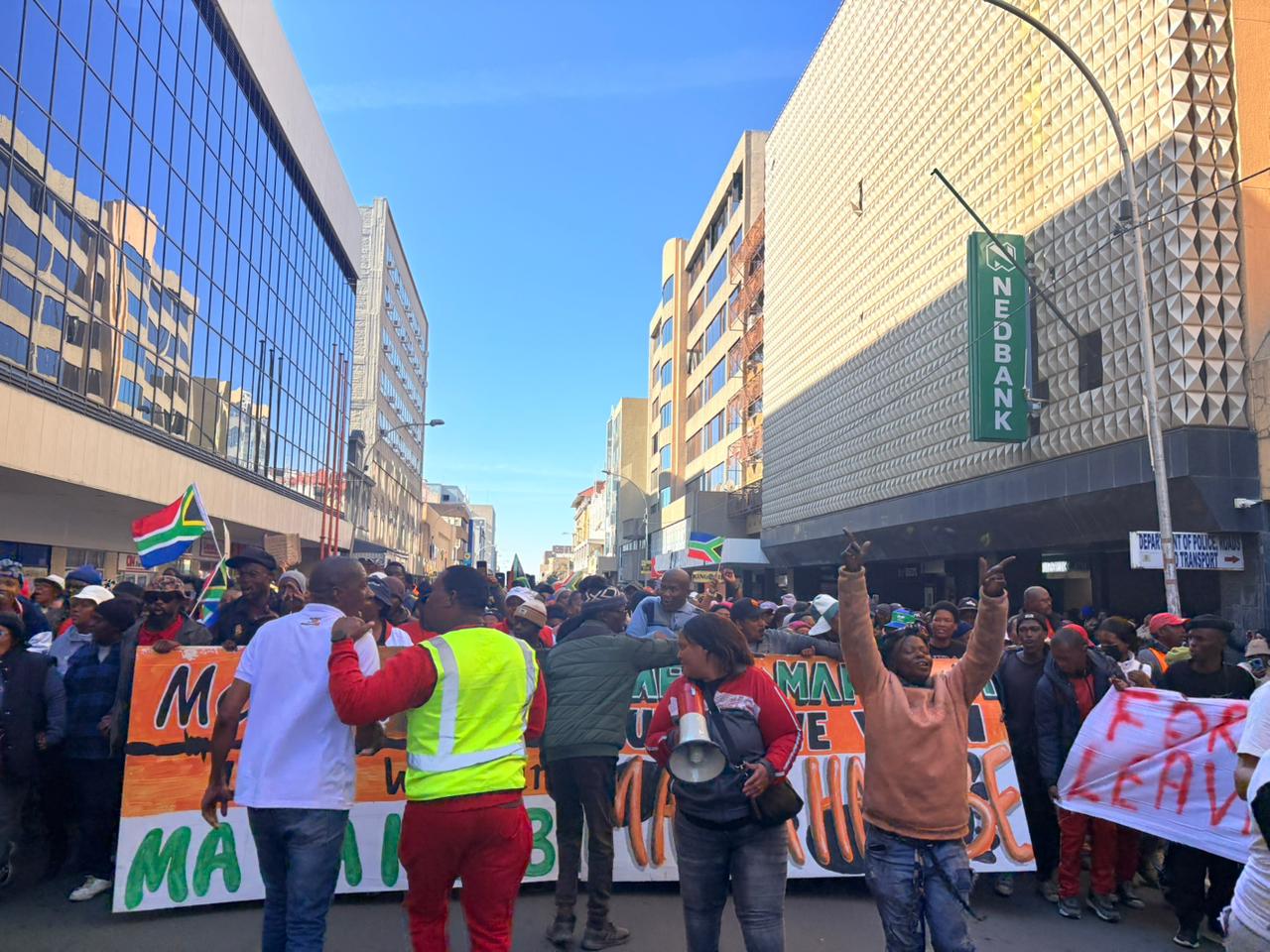
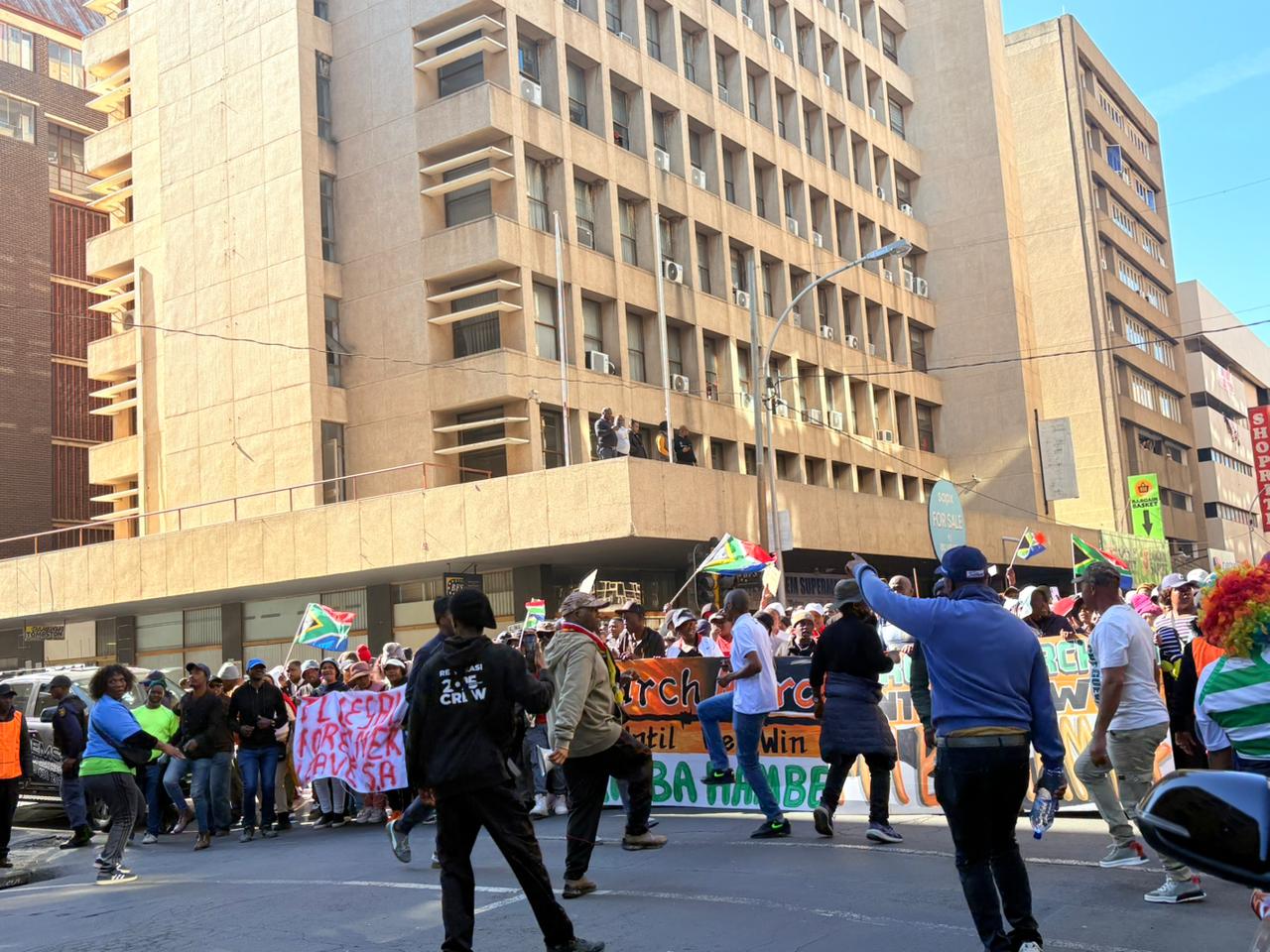
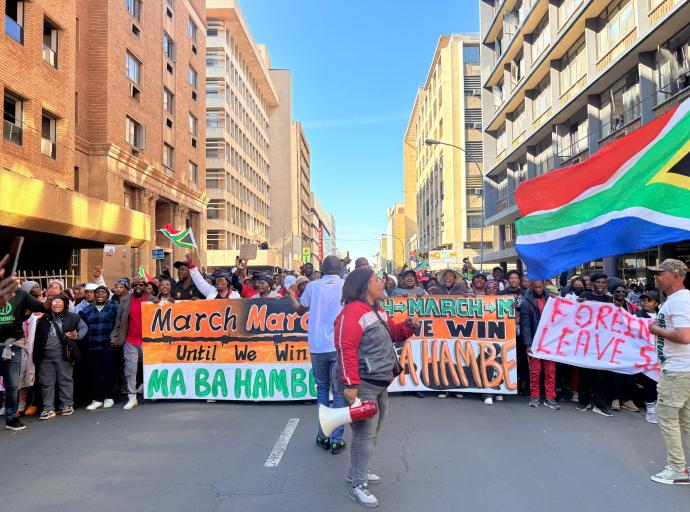
Thousands of South Africans today gathered across the country to demonstrate their dissatisfaction with illegal immigrants who have hijacked buildings, committing different crimes, and selling drugs.
Led by Tankiso Thobala, from 051 March and March, the march was a demonstration to a better future for their children and handed over a memorandum of demands to the Premier of the Free State MaQueen Letsoha-Mathae on what the residents want to see happen regarding the undocumented foreign nationals in the province.
Some of the grievances handed over are are that illegal and undocumented immigrants be deported, all businesses employing illegal immigrants be closed, and all shops belonging to undocumented foreigners be closed with immediate effect.
In Pretoria this morning the March and March memorandum was addressed to the South African President Cyril Ramaphosa.
They emphasized that the march was not directed to any person based on nationality, race, or ethnicity, but is directed at the government for failure to uphold the constitution.
“What brings us here today is our children whose future is being destroyed by what is currently happening in our country while we are looking,”Thobala said.
Upon receiving the memorandum of demands, Letshoha-Mathae, thanked the organizers for putting together a peaceful march, which she said indicates that they indeed wanted to be heard.
“The leadership you showed so that people understand that you are delivering important document, in which you want response to. So on behalf of the Free State government, I would like to thank you and the team that is in front here for the behavior you have displayed and keeping your promise that you will not cause any destruction because you want to be heard,” she.
She also encouraged people to lookout for their country because they have found several foreign nationals with fake visas and marriage certificates.
Letsoha-Mathae also promised that they will go through the memorandum and as government will send it to the presidency and different departments.
A major police raid in Mangaung has resulted in the arrest of the husband of a senior metro politician after authorities allegedly discovered 28 undocumented foreign nationals being housed at a local property, sparking political controversy amid nationwide protests against illegal immigration.
The arrest took place earlier on Tuesday following information received by investigators about a property suspected of being used as a safe house for undocumented foreign nationals.
Police descended on the premises and found 28 foreign nationals from different countries, who were also taken into custody for processing.
The arrest comes as citizen-led movements across South Africa staged nationwide protest marches demanding stricter action against undocumented foreign nationals.
The development has sent shockwaves through the Free State, with Premier MaQueen Letsoha-Mathae confirming that preliminary investigations indicated the individuals had been staying at the property for about seven days.
The Premier further revealed that the property allegedly belongs to a senior politician in the Mangaung region.
“What is also concerning is that the owner of the guesthouse is one of the senior politicians in the region of Mangaung. That's where it is really worrying, but for now the police are still doing their work,” she said.
Letsoha-Mathae added that the politician's husband had not yet been formally charged and would be transported to the nearest police station for processing while investigations continue. He is expected to appear in Bloemfontein magistrate court soon.