President Cyril Ramaphosa will today, 10 October 2026, officially inaugurate the transformative Free State Catalytic Investment and Industrialisation Project in Phuthaditjhaba, QwaQwa.
The massive R100-billion venture, hosted alongside Free State Premier MaQueen Letsoha-Mathae and Chinese investors...
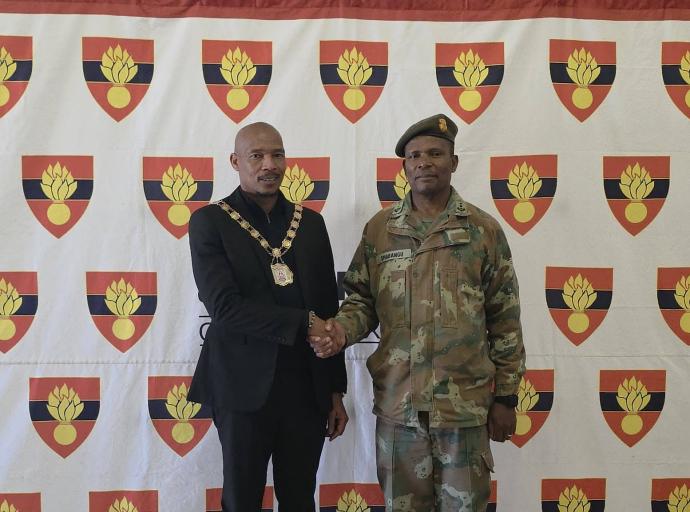
Moqhaka Local Municipality is exploring opportunities for stronger collaboration with the South African National Defence Force (SANDF) following a high-level stakeholder engagement between municipal leadership and the SANDF School of Engineers.
Led by Executive Mayor Cllr Ramasimong Tau, the meeting formed part of the municipality’s ongoing efforts to build strategic relationships that can contribute to improved service delivery and community development.
The engagement focused on strengthening institutional relations and identifying areas of mutual interest that could pave the way for future partnerships. Discussions also explored how the municipality and the SANDF could work together on initiatives aimed at addressing service delivery challenges and enhancing support to local communities.
The meeting was attended by SANDF School of Engineers Officer Commanding Colonel Shabangu, alongside key members of the municipal leadership. These included MMC for Public Safety Cllr Morena Thebe, MMC for Human Settlements and Spatial Planning Cllr Thabo Mofokeng, MMC for Technical Services Cllr Itumeleng Sesing, and Acting Municipal Manager Ms Lizzy Ntsepe.
Mayor Tau described stakeholder engagement as a critical component of the municipality’s development agenda, noting that partnerships with strategic institutions such as the SANDF can unlock expertise, resources and innovative solutions that benefit residents across the Moqhaka municipal area.
Matjhabeng Local Municipality has intensified efforts to tackle persistent raw sewage spillages in Welkom, responding to long-standing complaints from residents about deteriorating sanitation infrastructure.
On Tuesday, municipal officials, together with the Department of Water and Sanitation (DWS), conducted an inspection of ongoing intervention projects, including a major sewer repair at the corner of Blesbok and Anderson streets in St Helena. The area has been severely affected by sewage overflows, posing health and environmental risks to nearby businesses, schools, shopping centres and residents.
Executive Mayor Thanduxolo Khalipha said the intervention follows a request by the municipality for national government support after assessments revealed widespread damage to sanitation infrastructure.
According to Khalipha, more than 54 pump stations and 11 wastewater treatment plants were found to be dysfunctional, prompting the municipality to seek assistance from DWS.
The department has appointed contractors to replace a collapsed section of sewer pipeline caused by an ageing sanitation network. Municipal officials reported that the project is already 40% complete, with excavations undertaken and parts of the pipeline replaced.
The repair work is expected to be completed by August 2026, a milestone that officials believe will permanently eliminate sewer spillages in the affected area.
DWS also urged residents to avoid flushing foreign objects such as rags, newspapers and hairpieces down toilets, warning that blockages contribute significantly to overflowing manholes and place additional strain on municipal resources.
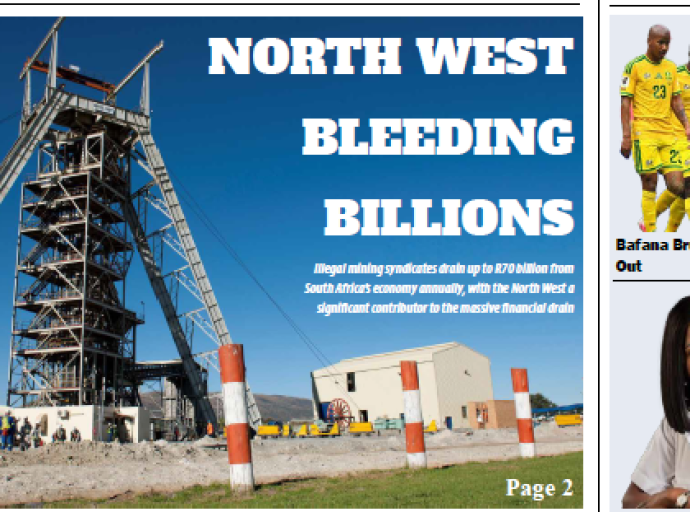
Criminal syndicates and unauthorised chrome wash plants are draining an estimated R60 billion to R70 billion from South Africa’s economy every single year. This staggering multi-billion-rand financial drain directly undermines the North West provincial government’s massive efforts to stimulate legitimate economic growth and job creation.
The scale of this catastrophic loss was laid bare during recent deliberations before the North West Provincial Legislature’s Portfolio Committee on Economic Development, Environment, Conservation and Tourism.
Lawmakers warned that vast public investments are being completely neutralised by highly sophisticated illicit networks exploiting regulatory loopholes.
The provincial government, however, continues to pour billions into mining infrastructure, including an allocation of more than R1 billion to the Department of Economic Development, Environment, Conservation and Tourism (DEDECT).
Furthermore, Public Works and Infrastructure received R4.2 billion to improve transport networks, while major private players like Harmony Gold and Valterra Platinum have committed R1.5 billion and R17.8 billion respectively.
Yet, every truck carrying illegally mined chrome out of the province represents revenue that never reaches government coffers through unpaid taxes and vanished royalties. For the North West, which sits on some of the world’s richest chrome and platinum deposits, the economic and social implications of this theft are severe.
The committee heard that out of 70 chrome wash plants inspected during the current financial year, a shocking 30 facilities were found operating without any environmental authorisations. Despite these blatant violations, only seven criminal cases have been opened, exposing a severe crisis in enforcement capacity.
What has further alarmed lawmakers is that only three environmental compliance inspectors are currently responsible for monitoring activities across the entire Bojanala District. This overstretched workforce is expected to police dozens of wash plants and massive mining operations spread across South Africa’s busiest mining hub.
The damage also extends far beyond lost revenue, with residents reporting extensive river pollution, illegal waste discharges, and severe land degradation. Taxpayers are ultimately left to foot the multi-million-rand bill for treating contaminated municipal water and repairing roads broken by heavy illicit mining vehicles.
Departments responsible for mining regulation, environmental protection, water management, labour compliance, policing, and immigration frequently operate independently. This fractured, uncoordinated approach between state agencies creates massive gaps that organised crime syndicates easily exploit to traffic resources.
Portfolio Committee Chairperson, Mpho Khunou, warned that local communities continue to bear the devastating environmental and safety costs while seeing absolutely zero economic benefits.
The committee has now demanded a comprehensive audit of all mining and chrome wash plant activities across the province.
“Communities are suffering environmental damage, water pollution and unsafe mining activities while the province is not benefiting economically from these operations,” Khunou said.
Unless enforcement improves dramatically and state agencies unite, experts warn that taxpayers will continue funding ever-growing cleanup costs while syndicates profit from the province's mineral riches.
The urgent question confronting authorities is how much longer the country can afford to lose tens of billions annually to the very networks undermining its economy.
Public anger is reaching a boiling point in Mangaung as residents prepare to descend on the Batho Magistrate's Court this morning, demanding justice for a 21-year-old student teacher who was allegedly assaulted in a shocking road rage incident that has sparked nationwide outrage.
A 22-year-old man is expected to appear before the court in connection with the attack, which was captured on video and went viral on social media. The footage, showing the young woman being verbally and physically assaulted by members of a family, has reignited debate around gender-based violence (GBV) and the treatment of women in South Africa.
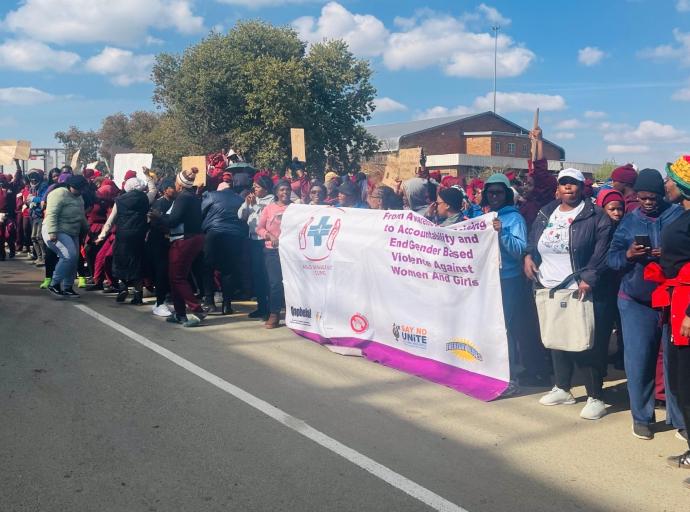
The growing public outrage was evident on Thursday when activists, survivors, and civil society organisations marched through Rocklands, Bloemfontein, in a demonstration against GBV. While the march formed part of ongoing efforts to raise awareness about violence against women, participants said the attack on the student teacher had intensified calls for action.
According to police spokesperson Sergeant Mahlomola Kareli, the alleged perpetrator was briefly detained before being released with a warning to appear in court on June 12.
"He was briefly detained and released with a warning to appear in court on June 12. The law does not allow police to arrest anyone for common assault unless it is related to domestic violence," Kareli explained.
Community activist and march organiser Donny Ntai said many residents were angered by the decision to release the suspect.
"The march today is about raising awareness of gender-based violence for our women. Everyone was upset about the video circulating yesterday of the assault on Masego. This is a peaceful march to highlight that no man should lay his hands on a woman," said Ntai.
The incident has triggered widespread discussion about the safety of women, particularly students and young professionals, and renewed concerns about violence in public spaces.
GBV ambassador for the Free State, Rozane Hugo, said the attack highlighted the persistent challenges facing women.
"As GBV ambassadors, we stand against the abuse of females. The fact that a man was the perpetrator and other men watched the girl being abused without intervening illustrates that GBV and femicide remain significant problems in our city and country," she said.
Hugo added that the march was also intended to amplify calls for justice in unresolved GBV cases.
Thoko Nogabe of Buang Basadi stressed that peaceful demonstrations remain a powerful tool for demanding accountability.
"We must remain non-violent during these marches; otherwise, we risk mirroring the perpetrators. We refuse to let our girls live in fear of being attacked. We are standing up against GBV; we demand justice for Masego," she said.
Social worker and GBV ambassador Zandile Shezi said the march was also aimed at encouraging victims to report abuse and assuring communities that justice can be achieved.
Political leaders have also condemned the incident.
Free State Premier MaQueen Letsoha-Mathae described the attack as barbaric and said it was a stark reminder that the fight against GBV remains far from won.
"I join the people of our province in condemning this barbaric attack on a defenceless woman by a violent man. There is absolutely no justification for such violence. We appeal to our law enforcement agencies to bring the perpetrators to justice and impose severe sentences on them," she said.
MEC for Community Safety, Roads and Transport Jabu Mbalula also condemned the assault, expressing concern that women were among those involved in the attack instead of protecting the victim.
He called on the police to ensure that all those responsible are held accountable.
As the court appearance approaches, community organisations say they will continue to mobilise residents, insisting that the case must serve as a clear message that violence against women will not be tolerated.
Months of uncertainty surrounding the controversial Bodulo Mothong housing project could come to an end today when the Free State High Court delivers judgment in a closely watched legal battle that could determine the future of hundreds of vulnerable families awaiting relocation to safer living conditions.
The fate of Mangaung Metro Municipality’s housing programme now rests in the hands of the court after arguments in a dispute between the municipality and the Democratic Alliance (DA) were heard on Thursday, 4 June 2026.
At the centre of the matter is land in Lourier Park earmarked for the relocation of residents currently living in informal settlements situated in hazardous areas across the metro.
After hearing submissions from both parties, the court reserved judgment and announced that its ruling will be handed down at 10:00 on Friday, 5 June.
Mangaung Metro MMC for Planning and Human Settlements, Councillor Ntombi Nhlapho, said the municipality remains confident that the court's decision will support efforts to provide safer living conditions for vulnerable residents.
According to Nhlapho, the Bodulo Mothong programme was established to relocate families living in dangerous environments, including flood-prone areas, wetlands and beneath high-voltage electricity infrastructure.
"The primary objective of the programme is to save lives," she said, adding that many residents remain exposed to significant risks during severe weather conditions and that the municipality has a responsibility to provide land that is safe for human habitation.
The DA, however, has challenged the municipality's actions, arguing that the proper legal processes were not followed in the allocation of the Lourier Park land.
Despite the legal dispute, several residents who support the relocation programme attended the court proceedings and voiced frustration over delays in securing permanent housing.
Thabang Moabi, a resident of an informal settlement in Naledi, said political disagreements should not stand in the way of people accessing safe housing.
"We are hurt when political parties oppose the allocation of municipal land for housing. We just want a place where we can live safely," he said.
Another resident, Joseph Makae, described the difficult conditions faced daily by families living in informal settlements.
He said many residents live near quarries, dams and illegal dumping sites, while basic services such as electricity, sanitation and proper road infrastructure remain unavailable.
"There are dangers everywhere. Children can fall into the dams, the roads become inaccessible when it rains, and we have no toilets or electricity. We need to be moved to a better place," said Makae.
The court's ruling is expected to determine whether Mangaung Metro can proceed with the Lourier Park relocation project or whether additional legal processes will be required before the programme can move forward.

_thumbnail.jpg)
 (2)_thumbnail.png)