About 1,392 students at the Central University of Technology (CUT) Welkom Campus are set to receive their accommodation allowances directly from the university.
This commitment was made during an intervention meeting by the Deputy Minister of Higher Education and Training Yusuf Cassim who visited t...
The three-day Cataract Marathon, held over the weekend at Boitumelo Regional Hospital in Kroonstad, was a great success, with over 100 patients receiving treatment.
Screening was conducted last week Friday with cataract operations scheduled for Saturday and Sunday.
According to a press release from the Free State Department of Health, patient safety was prioritised, and theatre lists were finalised based on vital signs.
"Blood sugar and blood pressure were monitored on the day. If levels were found to be high, patients were scheduled for another appointment to ensure they could still benefit from these life-changing surgeries," stated Bongi Mthimkhulu, the CEO of Boitumelo Regional Hospital.
This initiative follows a pledge by Free State MEC for Health Monyatso Mahlatsi, during his department budget vote, to restore surgical capacity, reopen underutilised theatres, and improve access to specialist care in public hospitals. The province is currently facing a cataract backlog of over 1,000 patients.
The department has also confirmed plans to reopen and strengthen theatres at several facilities across the province, including Thusanong Hospital, Katleho Hospital, Albert Nzula Hospital, Mafube Hospital, Fezi Ngubentombi Hospital, Elizabeth Ross Hospital, National District Hospital, and the neonatal unit at Dihlabeng Regional Hospital.
Build One South Africa (BOSA) leader, Mmusi Maimane, has officially availed himself to chair the newly formed 31-member parliamentary committee set to consider the possible impeachment of President Cyril Ramaphosa.
According to a report by the Sunday Times, Maimane’s willingness to steer the high-stakes inquiry comes amid an intense drive by opposition political parties to block the African National Congress (ANC) from taking control of the process.
The committee is scheduled to meet for the first time to elect a chairperson and establish the roadmap for investigating the 2020 Phala Phala game farm scandal.
According to The Sunday Times opposition formations are actively leveraging their superior numbers to ensure the probe into the theft of over 580 000 US dollars (around R9.8 million at the time) remains strictly independent of executive influence.
Maimane confirmed that multiple opposition parties have already approached him to lead the multi-party panel, citing his position outside the Government of National Unity (GUN) as a key advantage.
“I have been approached by a number of political parties who have said: ‘Look, you are outside of the GNU, you have got the legal integrity, would you be available to chair this committee?’” Maimane revealed.
“And I have said yes, I am available,” he added.
The ANC finds itself in a highly vulnerable legislative position - holding a mere nine seats on the 31-member panel. The remaining 22 seats are held by opposition benches, stripping the ANC of the absolute majority it historically relied on to shield its leadership.
Furthermore, the ANC intends to nominate former deputy chief whip, Doris Mpapane, who currently chairs the portfolio committee on the Presidency.
However, opposition leaders are fiercely lobbying for a non-GNU candidate to guarantee public credibility and legal impartiality, according to The Sunday Times.
Compounding the ANC’s dilemma is the cautious stance of its primary coalition partner, the Democratic Alliance (DA), which holds five seats on the panel.
DA leaders are believed to be quite hesitant to claim the chairmanship themselves, fearing that leading the impeachment process could create a conflict of interest and destabilise the national coalition if adverse findings are made.
Meanwhile, smaller political formations are digging in their heels to ensure GNU partners do not compromise the integrity of the constitutional process.
African Transformation Movement (ATM) leader, Vuyo Zungula, whose party initiated the Ramaphosa’s impeachment calls, strongly backed the exclusion of all executive-aligned parties from the registry of potential chairs.
“The issue of Phala Phala is a parliamentary process, it's not a GNU process. The focus must be on restoring parliamentary oversight,” Zungula said, as quoted by The Sunday Times.
As the critical vote approaches, the ANC faces a daunting battle to protect its Ramaphosa within a fragmented parliamentary landscape it no longer controls.
Political tensions and allegations of selfish interests have emerged as major stumbling blocks in the reconfiguration of municipal troikas in the Nala and Masilonyana local municipalities, threatening efforts to stabilise governance and improve service delivery.
What was expected to be a smooth leadership renewal process has instead exposed deep divisions within party structures, with claims that some leaders are placing personal ambitions ahead of organisational unity and the interests of communities.
This comes despite the ANC provincial leadership, through spokesperson Thabo Meeko, earlier assuring this publication that the reconfiguration of seven struggling municipal troikas “has progressed smoothly”, with only a few internal matters still to be resolved in Nala and Masilonyana municipalities.
However, according to the party’s Regional Executive Committee (REC), the failure to finalise the process in the two municipalities is being driven by the narrow and selfish interests of certain provincial leaders and members of the municipal troikas.
Addressing a media briefing on Thursday, regional secretary Irvin Riet said the Lejweleputswa region was the only region where the implementation of the reconfiguration process had been selective, inconsistent and unfairly applied.
“Here in the region, only the mayor of the Lejweleputswa District Municipality has been reconfigured, while other components of the political leadership remain untouched despite the collective governance failures confronting this municipality. We are seriously concerned as the REC regarding the continued resistance by certain provincial officials to finalise the process in the district municipality, as well as in Nala and Masilonyana local municipalities,” said Riet.
The reshuffle, announced in August last year by ANC Free State provincial secretary Polediso Motsoeneng, was aimed at realigning political priorities, stabilising municipalities and accelerating service delivery.
Riet said even more concerning were allegations that the troika in Masilonyana had indicated that they would not vacate office until certain arrangements and undertakings made between themselves and some provincial officials were implemented.
“We note with concern the conduct of the troika in Masilonyana, whose refusal to comply with the organisational directive to resign has now escalated into open defiance of the REC,” he said.
Meanwhile, Meeko maintained that the process was progressing smoothly, with only two of the seven municipalities still expected to elect new mayors.
“The process is going smoothly and should be completed within a week or two. The organisation is currently finalising a few internal issues within Nala and Masilonyana local municipalities,” said Meeko.
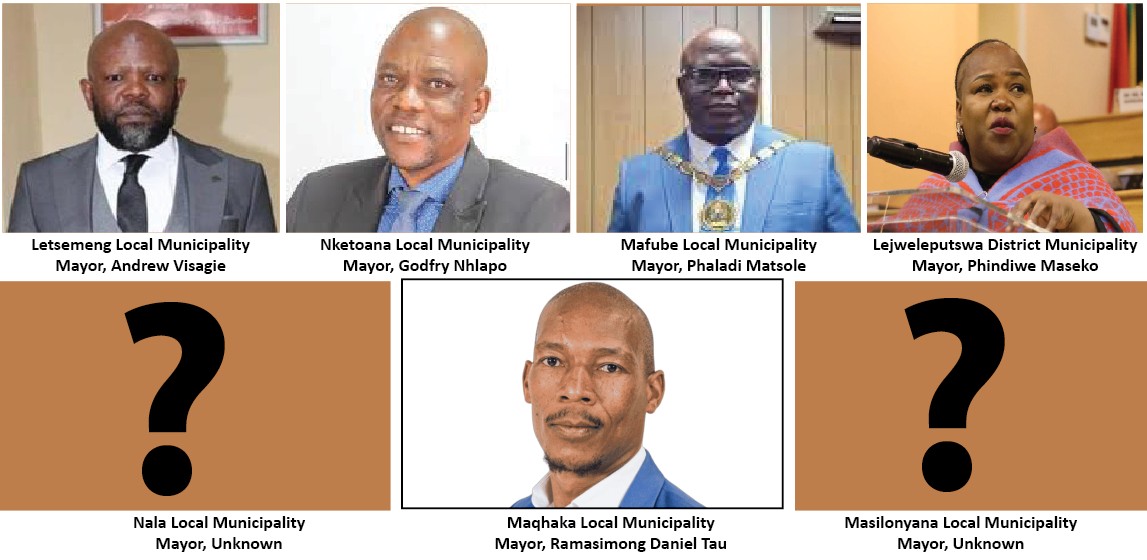
He welcomed the election of new mayors in Mafube, Moqhaka, Letsemeng, Nketoana and the Lejweleputswa District Municipality.
“We are happy as the ANC that capable leaders are being put in place to fast-track issues confronting the municipalities, including service delivery to the people,” he said.
Phaladi Matsole was recently elected as the new mayor of Mafube Local Municipality, while Ramasimong Daniel Tau was appointed mayor of Moqhaka Local Municipality.
Meanwhile, Andrew Visagie, Godfrey and Phindiwe Maseko were elected mayors of Letsemeng, Nketoana and Lejweleputswa District Municipality respectively.
The ANC in Mangaung is heading for a second attempt at holding its long-awaited regional conference, setting the stage for another high-stakes political showdown expected to test party unity, leadership stability and organisational discipline in the metro.
The region suffered a major setback earlier this month when the conference, convened to elect a new regional executive committee, dramatically collapsed at the eleventh hour after national deployee Thandi Moraka announced that her team had uncovered serious credential irregularities after voting had already concluded.
Among the concerns raised were allegations that at least eight additional ballot papers had been inserted into the ballot box by unknown individuals after the voting process had ended.
ANC Free State provincial spokesperson Thabo Meeko has since confirmed that the conference will reconvene from today.
“As per the directive from the national leadership, all processes of the conference will start afresh. The nullification of the conference was largely due to the ballot not tallying with the voters’ roll, and as such, all processes were cancelled, including the credentials. The rerun conference will adopt its own credentials and continue with its business,” said Meeko.
The decision follows an instruction by ANC Secretary-General Fikile Mbalula ordering a rerun of the Mangaung conference after a formal request by the Provincial Executive Committee (PEC).
In a letter addressed to Moraka and provincial secretary Polediso Motsoeneng, Mbalula directed that the conference be rerun on “a re-verified branch base, a re-issued Credentials Report and a properly signed-off voters’ roll.”
The letter, seen by Journal News, states that all procedural decisions taken during the abandoned conference have been nullified, including the adoption of a credentials report for 260 voting delegates.
“Every act purporting to flow from the day — the adoption of the Credentials Report (260 voting delegates), the unopposed declaration in respect of the Regional Treasurer, the cast and counted ballots, and every other procedural step — is set aside and of no force or effect. No certificate of outcome shall issue, no MMS update of any purported office-bearer shall be effected, and no public communication shall be made on the strength of those proceedings,” Mbalula wrote.
He said his office found that an unsigned voters’ roll, the failure to reconcile the attendance register with the adopted credentials report, eight excess ballots beyond the 260 accredited delegates, and lapses in venue access control had fatally undermined the credibility of the conference.
Rising unemployment, pressure on public services and growing tensions around undocumented foreign nationals are fuelling unrest across the Free State, with recent violence in Bloemfontein and Botshabelo exposing the fragile reality facing communities battling poverty and economic exclusion. More than 140 people were arrested during the latest outbreak of unrest in Mangaung, where foreign-owned spaza shops and informal businesses were looted as frustration over crime, joblessness and failing service delivery spilled onto the streets.
Concerns around undocumented foreign nationals, rising crime and worsening unemployment have increasingly sparked protests and community action across the province, highlighting how quickly socio-economic frustrations can escalate into violence.
During the recent unrest in Mangaung, several foreign-owned businesses were targeted as parts of Bloemfontein and surrounding townships descended into chaos. Police moved swiftly to restore order, confirming arrests linked to public violence, looting and property damage.
While authorities strongly condemned the violence, the unrest once again exposed deeper structural challenges facing the province, where thousands of households remain trapped in poverty and survival increasingly depends on informal economic activity.
South Africa’s unemployment crisis continues to deepen, with the country’s official unemployment rate climbing to 32.7% in the first quarter of 2026 after more than 300,000 jobs were lost nationally. The Free State remains among the hardest-hit provinces, recording an unemployment rate of 37.8%, the second highest in the country.
Youth unemployment continues to place enormous pressure on communities, with millions of young South Africans still unable to access meaningful work opportunities. Economists warn that this growing economic desperation is intensifying tensions in township economies where competition for limited income opportunities has become increasingly fierce.
In Mangaung and surrounding areas, limited formal job creation has fuelled the rapid growth of informal trading networks, where both South Africans and foreign nationals operate small businesses in retail, food supply and other services.
Analysts say the overlap between economic exclusion, unemployment and informal trade competition has become a recurring flashpoint in many communities.
These growing tensions formed part of a broader national discussion when the Justice, Crime Prevention and Security (JCPS) Cluster convened an urgent meeting at the Union Buildings on 25 May 2026.
The meeting brought together senior government and security officials, including Justice Minister Mmamoloko Kubayi, Defence Minister Angie Motshekga, Deputy Home Affairs Minister Njabulo Nzuza, senior SAPS leadership and representatives from protest movements involved in recent anti-illegal immigration demonstrations.
Government said the engagement aimed to address rising protests while shaping a coordinated national response to immigration enforcement, community stability and social cohesion.
Although no final policy document was adopted, officials agreed on a draft national framework intended to guide future interventions on xenophobia, racism and related intolerance.
The proposed framework focuses on strengthening coordination between Home Affairs, SAPS and intelligence structures on immigration enforcement, establishing clearer rules for public protests and rolling out social cohesion programmes aimed at preventing violence in vulnerable communities.
Political analyst Sanet Solomon described Mangaung as a “pressure cooker environment” where unemployment, weak service delivery and perceptions of exclusion are colliding.
“The issue is not only immigration,” Solomon explained. “It is the broader reality of communities struggling with limited economic access, where informal trade becomes both survival and a source of tension.”
Economist Professor Frederick CvN Fourie, a Research Fellow at the University of the Free State specialising in labour economics and unemployment, said the province’s weak labour absorption capacity lies at the centre of the crisis.
“When unemployment remains structurally high, especially among young people, informal markets expand by necessity,” he said. “That creates competition for limited consumer spending, and in environments already under pressure, it easily becomes politicised.”
Residents in Bloemfontein and Botshabelo describe daily realities shaped by joblessness, rising living costs and inconsistent service delivery. Informal businesses, many operated by foreign nationals, have become deeply embedded in township economies by providing essential goods and services, but they also increasingly become targets during periods of unrest.
Mangaung Executive Mayor Gregory Nthatisi has appealed for calm, warning that violence and looting only deepen economic hardship in already struggling communities. He urged residents to address grievances through lawful channels rather than vigilantism.
As government works toward finalising a national framework on xenophobia and related intolerance, the challenge remains whether policy interventions can move fast enough to respond to the lived realities of communities where unemployment, migration pressures and social frustration continue to collide daily.
The Northern Cape has secured an additional R85 million funding boost after stronger municipal spending and tighter financial management unlocked fresh investment for the province, marking a major win for Premier Dr Zamani Saul’s push to strengthen governance, improve accountability and accelerate service delivery across struggling municipalities.
The announcement was made during Thursday’s Extended Premier’s Intergovernmental Forum in Kimberley, where provincial leaders, municipal executives, government departments and public entities gathered to assess municipal performance, spending trends and long-term development priorities.
At a time when municipalities across South Africa continue to battle financial instability, ageing infrastructure and mounting service delivery pressure, the additional allocation is being viewed as a significant breakthrough for the Northern Cape and further evidence that the province’s governance reforms are beginning to produce measurable results.
Accountability and financial discipline dominated discussions at the forum, with provincial leadership making it clear that municipalities demonstrating stronger financial controls and improved spending patterns are placing themselves in a better position to attract further investment and support.
Premier Saul welcomed the progress achieved across several municipalities but stressed that stronger leadership and tougher accountability remain essential if local government is to sustain momentum and restore public confidence.
“Leadership comes with responsibility,” Saul told delegates.
“Leaders must occupy their positions fully, ask the necessary questions regarding expenditure and strengthen accountability measures to ensure clean audit outcomes.”
The Premier said clean audits should not simply be viewed as administrative exercises or compliance targets but as indicators of ethical leadership, transparent governance and government’s ability to deliver meaningful results to communities.
For the Northern Cape, the latest funding boost carries added significance as the province has spent several years working to stabilise municipal administration, strengthen governance systems and improve infrastructure delivery, often while operating under difficult economic conditions and limited resources.
The R85 million injection is expected to support critical development projects and strengthen municipal capacity to improve service delivery on the ground.
Provincial leaders also used the forum to align priorities between municipalities, departments and public entities, with discussions focusing on infrastructure delivery, municipal financial management, economic growth and improving coordination across all spheres of government.
For municipalities facing growing public pressure over service delivery failures, the message from provincial leadership was direct — better spending and stronger financial controls are no longer simply governance requirements, but essential tools for attracting investment and unlocking development opportunities.
The province’s improved financial performance, highlighted during the forum, reinforces the view that stronger governance can directly translate into additional resources and greater flexibility to respond to community needs.
This remains especially important in a province where many communities continue to grapple with infrastructure backlogs, unemployment and rising expectations around municipal performance.
Thursday’s meeting also reinforced Saul’s broader vision of building what provincial leadership described as a modern, growing and successful Northern Cape, with accountability and responsible public spending remaining central to that strategy.
Provincial leaders believe long-term economic growth will depend not only on attracting investment but also on restoring confidence in public institutions and ensuring government spending produces visible improvements in communities.
For Saul, the latest funding boost is expected to strengthen confidence in the province’s current direction.
For municipalities across the Northern Cape, however, the announcement also serves as a reminder that improved governance can deliver tangible rewards and that when financial discipline improves, the benefits can extend far beyond balance sheets into communities struggling for better services and economic opportunities.
In a province determined to prove that disciplined leadership can produce real results, Thursday’s R85 million allocation was more than another budget announcement. It was another sign that the Northern Cape’s push for accountability and stronger governance is beginning to translate into measurable gains for communities across the province.