Months of uncertainty surrounding the controversial Bodulo Mothong housing project could come to an end today when the Free State High Court delivers judgment in a closely watched legal battle that could determine the future of hundreds of vulnerable families awaiting relocation to safer living cond...
The wife of a man who was killed in a fatal shooting following a violent road rage incident in Emmarentia, Johannesburg, could be charged for handing a gun to her husband during an argument.
Human rights lawyer and director of civil society Accountability Now, Advocate Paul Hoffman, said she could be arrested for “aiding and abetting” her husband in attempting to shoot the 58-year-old man, who is now a suspect after killing her husband.
The incident, which resulted in the death of 48-year-old Faisal ul Rehman and left his wife, Tehseen, in a critical condition, reportedly began with a minor bumper-bashing and a dispute over overtaking on Barry Hertzog Avenue on Sunday afternoon.
According to police, during the verbal argument between the two drivers, Tehseen allegedly retrieved a firearm from their vehicle, which led the suspect to draw his own weapon, leading to the shooting of Rehman and Tehseen, while their children watched in horror.
Rehman was declared dead on the scene, while Tehseen was taken to the hospital.
The National Prosecuting Authority (NPA) said that there was insufficient evidence to proceed with the case at this stage. The case may be re-enrolled once the police have completed further investigations.
Hoffman said that although this was a difficult case, it could have been the other way around if the suspect had not been armed.Chatsworth family disappointed as murder charge against their son's alleged killer is provisionally withdrawn
“She was arming someone who was in a fight, and if the person who was intruding had not been armed, it might have been the other way around, and the husband would have been accused of murdering the man who is now the suspect in the case.
“If she is arming a person who is in a fight with somebody who is unarmed, which is what she knew at that time (I don’t think she would have pulled a gun if she knew that the man she was fighting with her husband had a gun), she would be guilty of aiding and abetting her husband to shoot the suspect,” he said, adding that he understood why the NPA did not jump to any conclusion as the suspect could have acted in self-defence.
Asked if this was possible, Gauteng police spokesperson Colonel Dimakatso Nevhuhulwi said investigations are ongoing, adding that police will communicate updates as they arise.
Meanwhile, the founder of Arrive Alive, Advocate Johan Jonck, said that even though there is no specific law concerning road rage, this case falls under normal common law crime, which includes assault, attempted murder, and murder.
He said the court would have to look at whether there was self-defence and whether the suspect acted reasonably.
“It has to look at what his intention was and if he really felt that his life was in danger in order to establish if there was an intention for murder, which is a normal criminal procedure,” he said.
Non-profit organisation Gun Free South Africa (GFSA), said the legal standards governing firearm use remain strict, including on the road.
The organisation’s executive director, Dr Stanley Maphosa, said that although Section 13 provides for licensing a firearm for self-defence, it does not create a blanket right to introduce a firearm into conflict.
“Lawful use still turns on narrow principles of immediate threat, necessity and proportionality. We would also draw attention to Section 120, which addresses negligent and reckless conduct involving firearms, including conduct that may endanger others in public spaces. Roads are shared public spaces. That matters,” Maphosa said.
He added that the issue is not only whether a gun is legal or illegal, or whether an owner is ordinarily law-abiding. It is whether a lethal tool is being introduced into conditions where emotions are heightened, judgment is impaired, control may be compromised, and public risk expands rapidly.
The Motor Industry Staff Association (MISA) said road rage is not only a criminal justice issue but a societal challenge that requires collective responsibility. The union said motorists must remember that every journey carries risks, and a moment of anger can destroy lives forever.
“We call on all motorists to exercise restraint and never allow anger to dictate their actions. A minor collision or insult should never escalate into violence. South Africa cannot afford to lose more lives to road rage. Let us commit to protecting one another on our roads, for the sake of our families and our children,” said Martle Keyter, MISA’s chief executive officer for operations.
Jonck also warned that there were numerous incidents of road rage on the roads, which are the result of responses to aggressive and irresponsible, reckless, and inconsiderate driving.”
He said the most dangerous shift happens when drivers stop thinking and start reacting.
“Look out for these examples of selfish driver behaviour, and do not get involved; conflict can only continue to exist with participation,” he said.
“The best is… to let it go, do not get involved, and breathe.”
Jonck warned that confrontation rarely resolves anything and often worsens the outcome.
“A physical or verbal confrontation is not going to repair vehicle damage or make the roads safer,” he said, adding that motorists should also consider the emotional state of other drivers.
"You may not know the other person's mental state, and many drivers have legal and illegal guns."
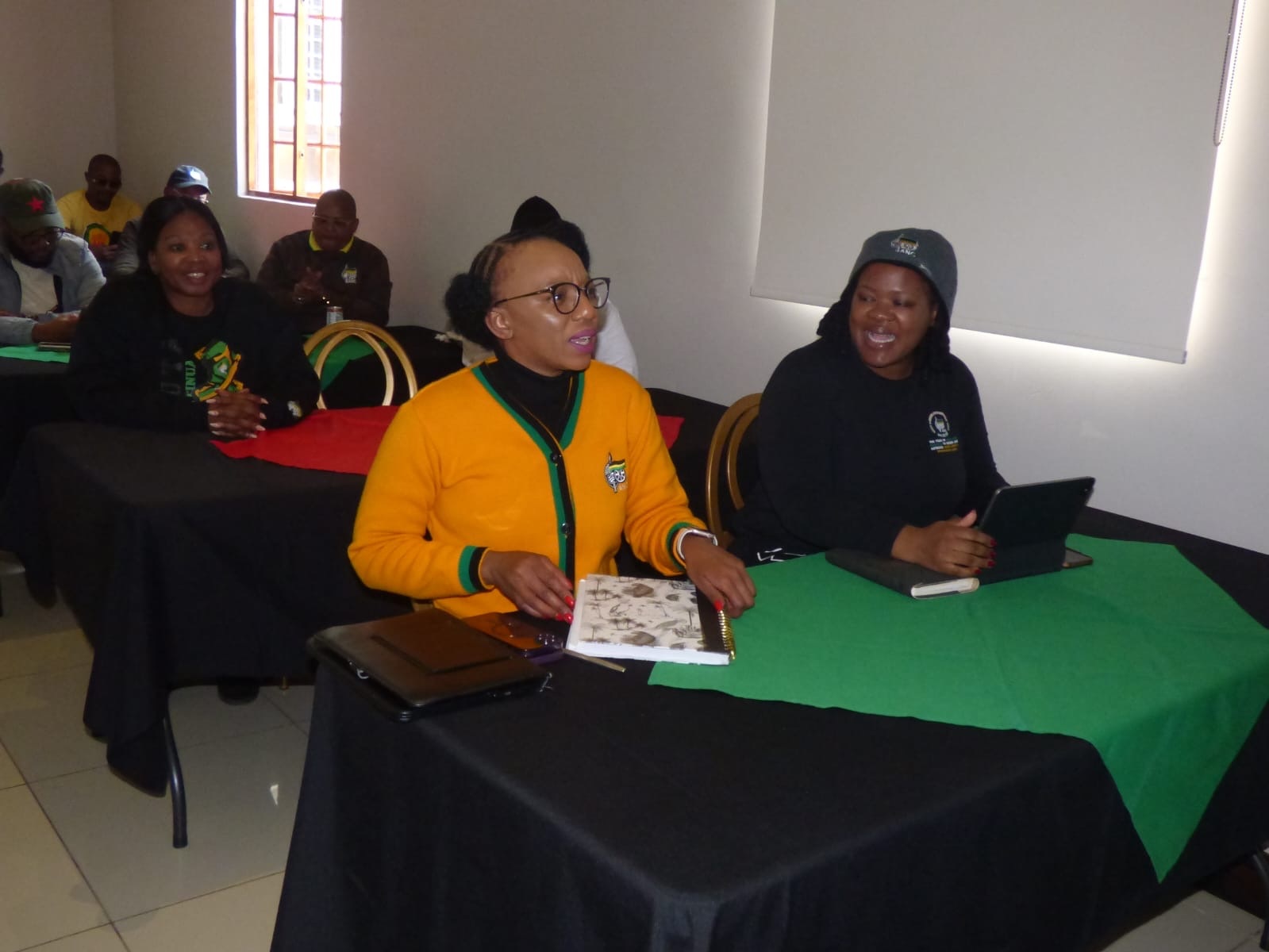
The African National Congress (ANC) Fezile Dabi regional conference has hit an early snag, with delegates still unable to complete the registration process.
Although branch registration was reportedly completed on Friday, a number of delegates from the Regional Task Team (RTT) and affiliated leagues have yet to be granted access to the gathering.
The party’s spokesperson, Mongamotse Tsotetsi, has confirmed that proceedings are expected to begin soon once the RTT meeting concludes.
“Currently, the leadership — comprising RTT and PEC members — is in a meeting to adopt the conference programme as well as the rules. Once that is concluded, we will proceed with the conference,” said Tsotetsi.
THE popular adage goes that war is the continuation of politics by other means, or at least that’s what Carl von Clausewitz, the Prussian general is posthumously published to have said in 1832.
He probably had conventional war in mind and its routines. In such conventional setting, the vicissitudes of politics tend to dictate the rhythm of war. In a battle of wits, however, where the party with more leverage tends to dominate, the sophistication of negotiations is the natural continuation of the battles of leverage by other means.
It may have been the verbosity of Trump or the cunning of the successor Ayatollah, no matter. But someone or some fortuity has led to the uniqueness of this happenstance. A kinetic war has quickly mutated into a war of leverage.
As such, it has quickly altered the calculus of victory by the US/Israeli led coalition, if ever there was one.
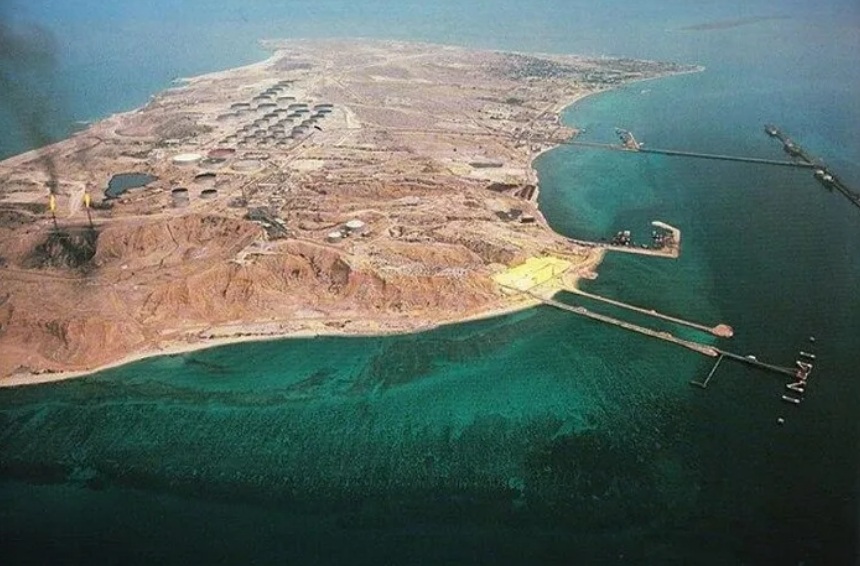
The sudden mutation from a war of muscle to a battle of wits had melodramatic consequences. A lot of calculations became imponderable permutations. A direct assault on the Kharg Island would be irreducibly suicidal.
There would be no sustainable logistical supply lines for the expeditionary assault units. Neither would there be adequate cover against an unceasing barrage of unmanned attack drones and bombardment by ballistic missiles from impenetrable jagged folds of the Zagros Mountains.
Besides, there are no convenient approach lines to the Kharg Island that would not expose the airborne divisions and the paratrooper forces to mortal harm. Every simulated attack scenario keeps revising the required forces from modest figures to ridiculously high numbers. From a modest number of 5000, the estimates are now sitting at 50 000.
In fact, the true scale of the plan as staggering as it is absurd, is borne of the realisation that there could be no attack on the Kharg Island without first implementing a regime change in Iran. Or put simply, the assault on Kharg Island would be a mission creep to eventually achieve a regime change.
Given the size of the Iranian landmass, even 200 000 Iraqi forces could not subdue an Iranian force half their cumulative strength. The US, therefore, will require a massive force approximating half a million men and women to achieve the absurdity called regime-change!
The Iranians had long understood that in all the projected war scenarios, from opening salvos to escalatory peaks, the curiosity of the politics of the United States will inevitably get mired in Iran’s political economy, especially of its production of oil and gas.
Particularly, when the hydrocarbon molecule is produced, to enquire where it is destined, if for no other reason than to determine which points of Iran’s economy or those of its partners, could be rendered militarily vulnerable.
Further that, the point of loading of these commodities in the Kharg Island and their passage through the Strait of Hormuz, present the attacking forces with strategically sensitive targets which by a single stroke, could cower the Iranians to a humiliating surrender.
This means therefore that the internal politics of the US and its regime change ambitions, were bound to dictate how its war against Iran, would be the continuation of its politics by other means.
The Iranians for their part, understood their leverage from day one.Or to be sure, they invested in the prescient identification and broad definition of such leverage. For one, the United States is too far away an adversary, located thousands of miles across the pond.
At any rate, they are too big to confront directly, renowned as they are for their apex dominance in the hierarchy of blue water navies. And in a conventional confrontation, they would immediately assume escalatory dominance.
From a long and acrimonious history with the United States and its allies, the Iranians had somehow learnt that all military power has definitive limits. Given all that dominance, the Americans could not master the tempestuousness of a Vietnamese bamboo jungle, nor were they endowed with enough patience to.
The expanse of the bamboo green shoots for their part, resplendent in their turgidity and intelligence, were empathetic to the plight of the Vietnamese hands that have nurtured them over the ages. That is leverage, so vast, so mysterious and indomitable.
Iran had to define its own leverage which would, in all probability, take critical factors into account. The primary consideration for Tehran, is that Israel as an attacking force, should be within reach and striking distance of their ballistic missiles’ stockpiles, and in that distance, must bear the brunt of their retaliation.
Second, the US military forces and forward mission assets including aerial defence batteries, are located all over the Persian Gulf and other proximate locations in the Gulf of Oman. Any retaliation should portend a commensurate effect both visually and politically, with surprising and demoralising effect, especially to the US electorate.
Third, that any pain suffered by the people of Iran because of the US/Israeli bombing campaign, shall in like manner, be horizontally extended to the Gulf states who are collaborating with the US and Israel in prosecuting this unprovoked and illegal war against them.
The Trump administration for their part, had to juggle many balls in the air to contrive a counterpoint to such capabilities, especially the most vantages of them all, the Strait of Hormuz. Any greater harm they could conceive to punish the Iranians, could in retaliation, be the same harm Iran will visit on its Gulf neighbours, including far removed Israel.
It would be as if Iran found the switch first. A little pain for Iran, a little pain for its neighbours. The conundrum for the invaders is fairly pronounced. The Strait of Hormuz is closed except for those ships that pay tribute of two million dollars equivalent in Yuan to Iran. Iran proposes to share that toll with Oman.
Trump contrived a plan. If he had one eye patch, he would be called Pirate Trump. For, the scheme involves blockading a blockaded strait. This time, the US blue water navy would lie in wait in the Indian Ocean, targeting ships passing through the Strait into the Gulf of Oman.
The thinking, it would seem, is that if Iran is blockading the Persian Gulf through the Strait of Hormuz, the US will blockade the Gulf of Oman, of any ship that passes through the beleaguered Strait.
This thinking posits a battle of tactic against leverage. If only the US president would have perused the translated pages of Sun Tzu’s war epic written circa 544 BC. But then again, Sun Tzu and his legacy is indubitably Chinese.
In that wise, why would Donald J. Trump be relying on the wisdom of the Chinese art of war to asphyxiate the Chinese oil economy? Make it make sense. After all, he has Netanyahu as his own personal Sun Tzu!
There could be no doubt that leverage, is a concentration of advantages. And what, pray tell, could be the difference between advantage and leverage.
From the lessons drawn out of this unfolding crisis, it would seem as if advantage, properly defined, is some tactical facet of a military strategy. Leverage on the other hand, is a facility provided by the quirks of the universe.
Much as General Vo Nguyen Giap of Vietnam enjoys the distinction of having been a master war tactician, combining minimalist resources with the leverage of a vast jungle, King Moshoeshoe II emerges as one of the greatest war strategists ever lived.
He had the ultimate leverage. He bivouacked his forces on the commanding heights of Thaba Bosiu. He vanquished all his enemies who tried to reach him at the zenith by liberally rolling down massive boulders on their advancing calvary.
Somehow, and this may not be completely accurate, Donald J. Trump has awoken to the reality that a nature endowed leverage is impossible to dislodge. He has therefore announced an indefinite ceasefire.
Not surprising. He now knows that leverage, of the ilk of the Strait of Hormuz, is a permanent force marjeure!
* Amb Bheki Gila Esq is a Barrister-at-Law.
* The views expressed here do not reflect those of the Sunday Independent, Independent Media, or IOL.
Observed annually on April 25, World Malaria Day shines a spotlight on the ongoing fight against one of the world’s deadliest mosquito-borne diseases.
By Bernell Simons
This year’s campaign message, “Drive to End Malaria: Now We Can. Now We Must,” calls for urgent global action to eliminate malaria and protect vulnerable communities.
The National Institute for Communicable Diseases has warned that malaria remains a serious public health concern, particularly in malaria-endemic provinces and neighbouring countries where warmer temperatures and seasonal rainfall increase mosquito activity.
From the Department of Health, spokesperson Mondli Mvambi, said awareness and early treatment remain key in saving lives. “Many people ignore early symptoms such as fever, chills, headaches and fatigue, thinking it is just flu. Delayed treatment can become fatal, especially for children, pregnant women and people with weakened immune systems,” she explained.
Malaria is caused by parasites spread through the bites of infected female mosquitoes. Medical professionals urge travellers and residents in high-risk areas to take preventative measures seriously, including using mosquito repellents, sleeping under treated mosquito nets and avoiding stagnant water around homes.
Mvambi added that community education and access to healthcare are essential in the fight against the disease. “Ending malaria requires collective action from governments, healthcare workers and communities alike,” she said.
World Malaria Day continues to raise awareness while encouraging investment in prevention, treatment and research efforts aimed at eliminating malaria globally.
As South Africa marks its 32nd Freedom Day since the dawn of democracy in 1994, commemorations are unfolding across the country from official state ceremonies to grassroots activism, political reflections and faith-based gatherings.
This year’s programme stretches beyond April 27 itself, with events beginning as early as Saturday, reflecting both celebration and contestation over what freedom means today.
Here’s a look at some of the key events shaping the national moment:
1. National Freedom Day celebration in Bloemfontein
At the centre of this year’s commemorations is the official government event, where President Cyril Ramaphosa is expected to deliver the keynote address in Bloemfontein.
Hosted at the Dr Rantlai Petrus Molemela Stadium on Monday, April 27, the celebration is held under the theme "Freedom & the Rule of Law — 30 Years of Democratic Citizenship".
The event remains the symbolic centrepiece of Freedom Day, reflecting on three decades of constitutional democracy while acknowledging ongoing challenges around governance, equality and access to justice.
While the state celebrates democratic milestones, social movements are using the weekend to spotlight what they describe as the "unfinished business of freedom".
Organised by Abahlali baseMjondolo, UnFreedom Day discussions will take place across three provinces: on Saturday, April 25 in Johannesburg, followed by Sunday, April 26 gatherings in Shakaskraal and Perdekop.
These gatherings are expected to focus on land access, housing insecurity, unemployment and the impact of proposed changes to eviction laws, with organisers arguing that millions remain excluded from the promises of 1994.
3. Afrika Mayibuye Movement’s ‘No Freedom Day’ in Soweto
In Soweto, the Afrika Mayibuye Movement will host a "No Freedom Day" community meeting on Sunday, April 26 at the Orlando Community Hall.
The event, led by Floyd Shivambu, is positioned as a platform to reflect on what organisers describe as the absence of "true freedom" for the majority, while also proposing solutions for economic and social reform.
4. IFP rally calls for governance reform
The Inkatha Freedom Party (IFP) will mark the day with its own commemoration in Westonaria.
Party leader Velenkosini Hlabisa is expected to use the platform to call for stronger accountability, ethical leadership and improved service delivery, framing Freedom Day as both a moment of remembrance and political mobilisation.
5. Faith leaders gather for anti-corruption pledge
In Cape Town, the South African Council of Churches will host a Freedom Day service at St George's Cathedral.
The service will include the signing of an Anti-Corruption Covenant by church leaders, underscoring the role of civil society and faith institutions in promoting ethical governance and accountability.
6. Housing conversations take centre stage in Cape Town
Also in Cape Town, urban activists and policy experts will gather for "10 Ways to Unlock Affordable Housing", hosted by Ndifuna Ukwazi and partners at their offices found at 125 Buitengracht Street.
The event will explore practical solutions to one of South Africa’s most persistent challenges, access to affordable housing, linking spatial inequality directly to the broader meaning of freedom in post-apartheid cities.
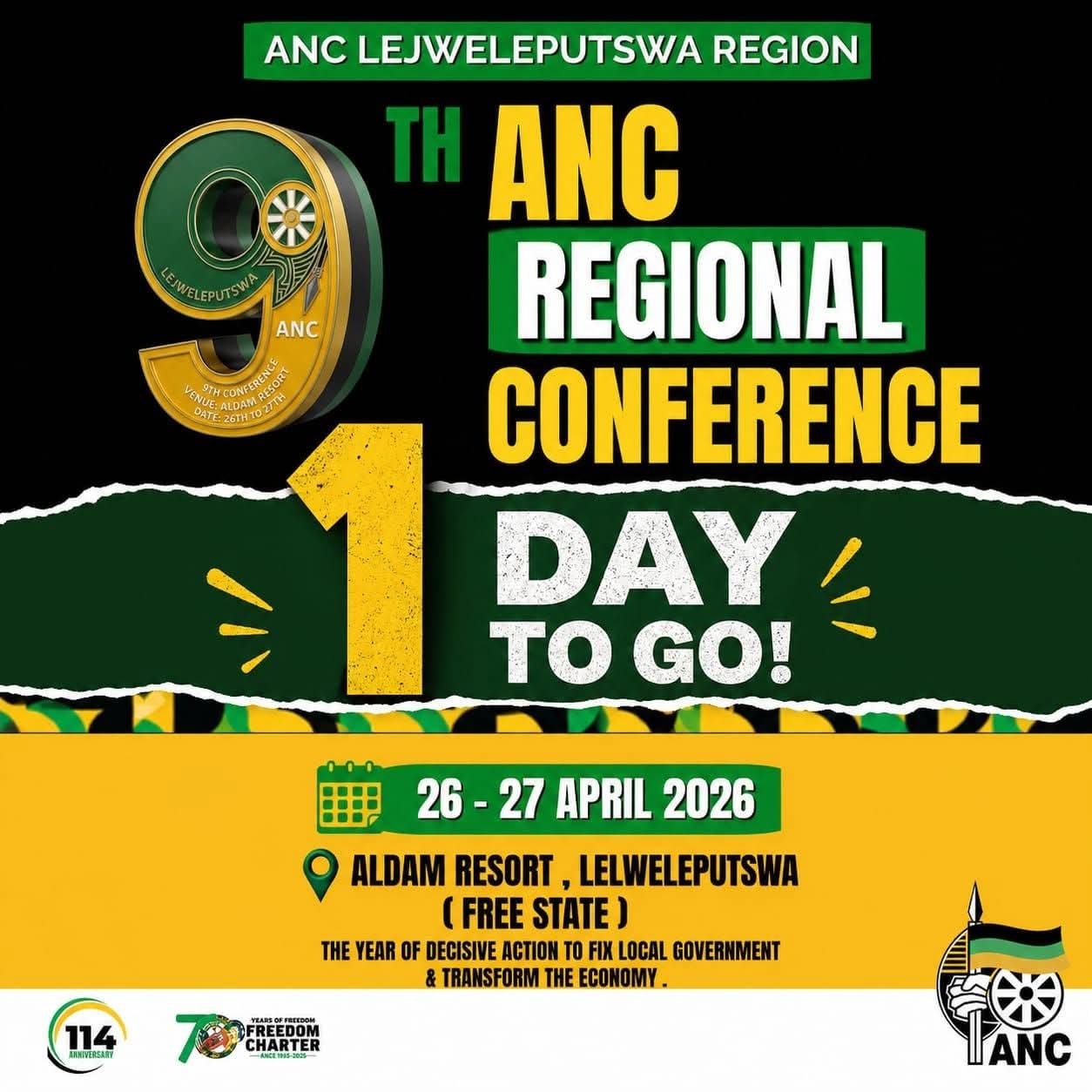
Just 1 day to go before the ANC Lejweleputswa Region gathers at Aldam Resort for its highly anticipated 9th Regional Conference — where leadership, renewal, local government challenges and the future of economic transformation take centre stage.
Aldam Resort, Lejweleputswa 26–27 April 2026
All eyes on Lejweleputswa as delegates prepare for crucial discussions set to shape the region’s political direction. #ANC #LejweleputswaConference #FreeStatePolitics



 Aldam Resort, Lejweleputswa
 26–27 April 2026