The newly elected Mayor of Maluti-A-Phofung Municipality, Tumelo Thebe, has wasted no time in setting the tone for his administration, unveiling an ambitious plan to restore dignity, improve service delivery, and rebuild public confidence in a municipality that has struggled with governance and infr...
Postbank has issued a warning to Sassa beneficiaries to be on high alert for individuals impersonating its officials.
It said that a disturbing trend has emerged, with social grant recipients using both the new Postbank black cards and the older Sassa gold cards being targeted by sophisticated fraud scams designed to steal their card and PIN details.
These scammers, pretending to be legitimate officials, are reportedly visiting beneficiaries at their homes.
They employ various deceptive tactics, often convincing recipients to hand over their cards and personal identification numbers by falsely claiming the cards are defective, require immediate repair, or that failure to comply will lead to the forfeiture of their grant payments.
But this is not true.
"Postbank assures social grant beneficiaries that there is nothing that requires fixing on any of its black cards and Sassa gold cards, and that both cards will continue to work beyond 31 May 2025 for the payments of their grants," a statement read.
In light of these concerns, Postbank has drafted the following crucial tips for beneficiaries to protect themselves from these scams:
·Never share your PIN: Postbank officials will never ask for your card's PIN.
·Beware of unannounced visits: Postbank or Sassa will never show up unannounced or without an appointment.
·NEVER EVER hand over your card: Do not give your Postbank Black Card or SASSA Gold Card to anyone. Your card and PIN are your personal keys to your money.
·Report suspicious activity: If you are approached by someone suspicious at your home
South Africa High Court dismissed a lawsuit filed by the opposition Economic Freedom Fighters (EFF) party that sought to stop the government from raising fuel levies.
Finance Minister Enoch Godongwana proposed the higher charges last month in his third attempt to present an annual Budget that can secure parliamentary approval. Previous iterations were rejected by the Democratic Alliance, the second-largest party in the nation’s 10-party coalition government, because they proposed hiking value-added tax.
The EFF, South Africa’s fourth-largest party, argued that raising fuel costs would hurt the poorest South Africans and undermine economic growth, and that proper procedures weren’t followed to introduce additional taxes.
Eastern Cape High Court secretary, Andiswa Mengo, claims she has received death threats following her sexual harassment complaint against the division’s judge president, Selby Mbenenge.
Mengo's complaint is the first ever that has led to a probe which could lead to the judge president's impeachment.
The top judge is accused of making unwanted sexual advances towards Mengo between 2021 and 2022.
The tribunal has so far heard evidence from expert witnesses who have corroborated some of the testimony provided by Mengo in May.
Hearings have been postponed to the end of June.
Mengo laid her official sexual harassment complaint against the division’s top judge in 2023.
Since then, Mengo has been working in the same division of the high court, taking leave from work each time the Judicial Conduct Tribunal sits to investigate the allegations she has levelled against Mbenenge.
Now, it’s alleged that she received a handwritten note at her desk which stated that a "bullet was waiting for" her.
During her evidence in chief before the tribunal, Mengo had also testified that she had received threats shortly after laying her complaint against the senior judge.
While the tribunal is expected to sit again from 30 June, it's expected that the panel will be mindful of this.
The matter has been escalated to the Office of the Chief Justice and law enforcement authorities.
*This article was first published by Eye Witness News
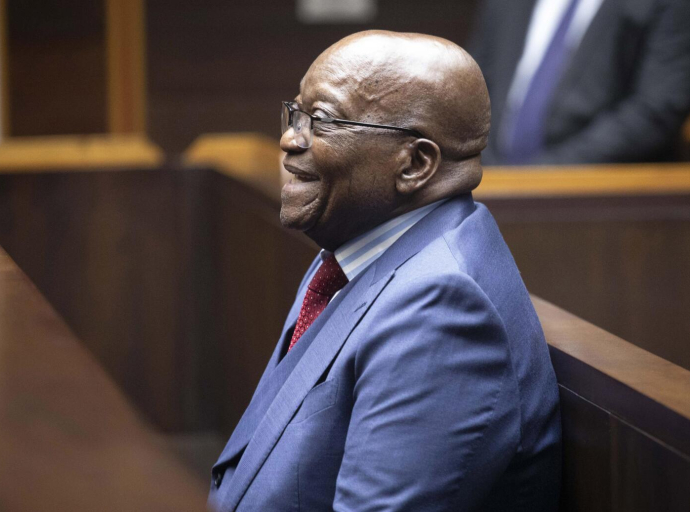
Zuma and French arms deal company Thales are charged with fraud, corruption, racketeering and money laundering linked to the controversial arms deal.
Former president Jacob Zuma’s corruption case is set to resume in December.
Zuma and French arms deal company Thales are charged with fraud, corruption, racketeering and money laundering linked to the controversial arms deal.
On Tuesday, the Pietermaritzburg High Court dismissed their application to have all charges against them dropped.
Judge Nkosinathi Chilli ruled that the matter would continue in December.
“This matter is adjourned to 4 December this year, 2025. The court will set aside two dates that is the 4th and 5th of December. Mr Zuma and Thales do not have to appear in court on that day.”
At the same time, Zuma has taken his fight to have State prosecutor Advocate Billy Downer removed from the case to the Supreme Court of Appeal.
In April, Justice Chilli dismissed Zuma’s application for Downer’s recusal.
*This article was first published by Eye Witness News
The Special Investigating Unit (SIU) is probing widespread corruption in several projects across the country funded by the Housing Development Agency (HDA).
According to the proclamation signed by President Cyril Ramaphosa, the SIU investigation will focus on serious maladministration in the HDA’s affairs in projects for provincial Human Settlements departments in the Eastern Cape, Free State, Gauteng, KwaZulu-Natal, Mpumalanga, North West, Northern Cape, and the Western Cape.
This includes the identification, acquisition, holding, development, and release of state, communal, and privately owned land for residential and community purposes by the agency, in its name, or for and on behalf of the provincial departments or by the departments in their name.
The unit will also investigate whether the contracts were awarded in a manner that was not fair, competitive, transparent, equitable, or cost-effective and contrary to applicable legislation, manuals, guidelines, practice notes, circulars or instructions issued by the National Treasury or the relevant provincial Treasuries applicable to the HDA and the departments.
The SIU is tasked with uncovering any related unauthorised, irregular, fruitless, or wasteful expenditure incurred by the HDA and the departments, or losses suffered by the agency, departments, or the state concerning the allegations.
In addition, the probe will look into any irregular, improper, or unlawful conduct by the applicable service providers of the HDA and the departments or any other person or entity, relating to the allegations.
Ramaphosa gave the SIU the green light to investigate serious maladministration in connection with the agency’s affairs and the departments, improper or unlawful conduct by employees, unlawful expenditure of public money and other offences referred to in the Prevention and Combating of Corrupt Activities Act committed in connection with the affairs of both the HDA and the departments.
The investigation will also tackle unlawful or improper conduct by any person, which has caused or may cause serious harm to the interests of the public or any category thereof, which took place between April 2016 and last month or which took place before or after the date of the proclamation but is relevant to, connected with, incidental or ancillary to the matters mentioned or involve the same persons, entities or contracts investigated under the proclamation’s authority.
The SIU is also empowered to recover any losses suffered by the HDA and the departments or the state.
In December 2023, the Sunday Independent reported that the then-Human Settlements minister, Mmamoloko Kubayi, demanded answers after a former agency official accused one of his bosses of approving about R20.3 million in pre-payments to consultants for the upgrading of the informal settlement programme (UISP) meant to benefit four Eastern Cape district municipalities in 2021.
The ex-employee stated that another former executive called him to a meeting in August 2021 and handed him a piece of paper with six companies that he wanted to benefit from the UISP in the Eastern Cape, which was valued at more than R270m for 2021/22 alone.
Education activist Hendrick Makaneta has amplified concerns about the R500 million contract for the printing and delivering of National Senior Certificate (NSC) examination papers in the North West province.
Weekend newspaper reports stated that the five-year contract with joint venture Lebone Altron DSV Consortium will cost the North West province R128 million annually.
On the other hand, the North West department of education has disputed the City Press reports, insisting that the five-year contract will cost the provincial authorities around R100 million annually.
Speaking to IOL, Makaneta who is the director of the Foundation for Education and Social Justice Africa said the contract was “too costly”.
“Spending R500 million on a contract for printing and delivering examination papers is very costly. While it is important to keep papers safe, this huge expenditure raises serious concerns about priorities and transparency. We still have shortages of textbooks and poor infrastructure,” said Makaneta.
“The North West department of education should disclose details of the contract with specific reference to a breakdown of costs, and public engagement on alternatives. Outsourcing must not come at the cost of accountability.”
Makaneta said the South African population deserves to know how learners will benefit from this whole process.
In an interview with broadcaster Newzroom Afrika, acting North West deputy director general for exams and curriculum, David Moroeng said the contract extends beyond the printing of examination papers.
“The contract that we have entered into is not only a contract for printing but it is a contract of what we call end-to-end, where we prepare question papers, we print and they are picked up and packaged. Once they are prepared (the question papers), they are going to be stored and then to the different storage points in the province under a secured environment,” he said.
“The previous service provider, that was two to three years ago, it was GPW (Government Printing Works) and we left GPW because we had a one-year SLA (service level agreement) that we had with them. We moved away and started looking for a new service provider.”
Moroeng said for the past two years, the North West provincial department was being hosted by their colleagues - the Gauteng department of education.
“We moved now, starting with our own tender process and we advertised, after advertising we got Lebone Litho consortium and also Altron DSV taking the bid,” he said.
Moroeng said the GPW contract was ranging around R27 million to 29 million but it was limited to printing.
“When we left GPW two years ago, we started paying around R80 million to R90 million in terms of printing. This year, when we started the new contract, we have added some new features that were not there, that is secured printing, secured transportation of the question papers within the province,” he said.
As part of the added services, Moroeng said the new service provider is mandated to transport answer books to the different marking venues across the province.