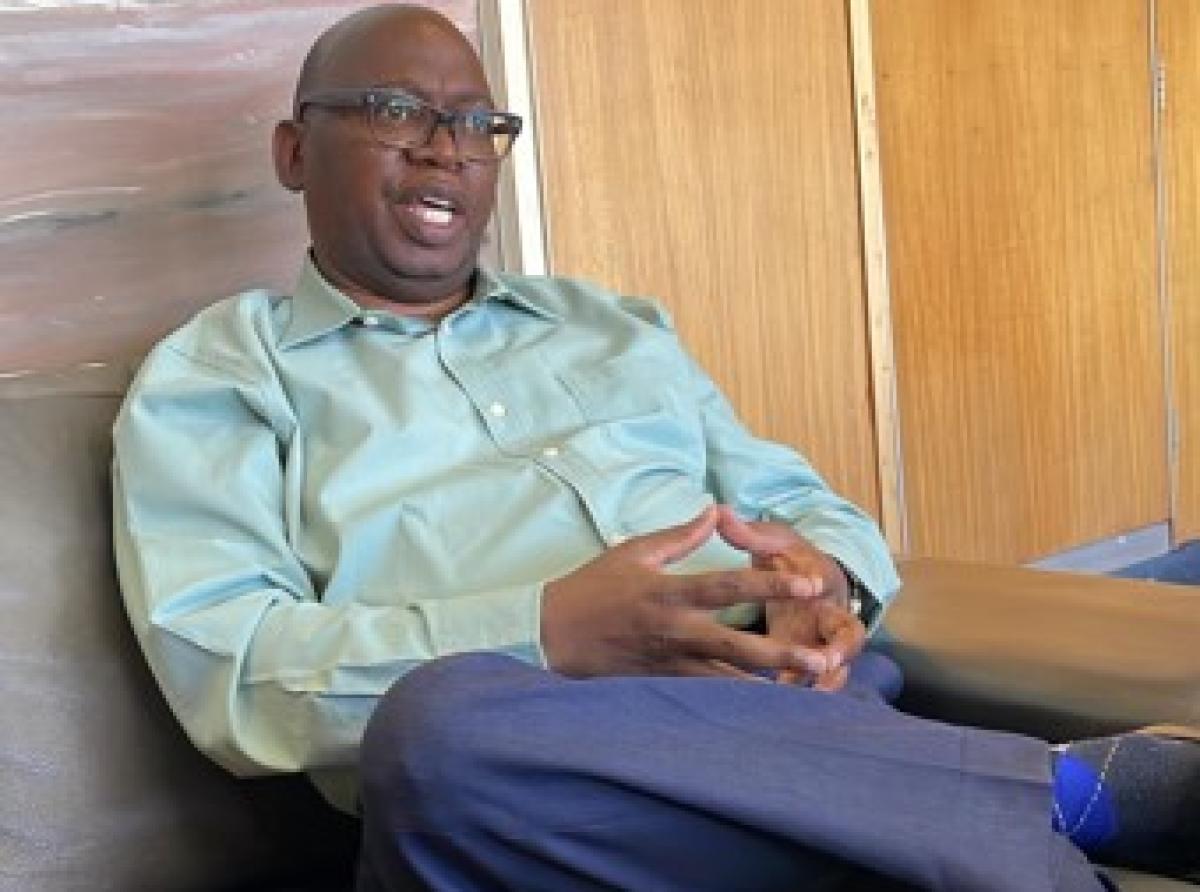
Stepping into office with a clear mandate to restore credibility and efficiency, the newly appointed Free State Director-General Dr Molefinyana Phera has vowed to root out corruption and incompetence across the provincial administration.
Journal News Editor-in-Chief Refilwe Mochoari sat down with Phera to unpack his vision, priorities, the challenges ahead and how he plans to rebuild public trust in government services.
With more than 30 years’ experience in governance and 22 years at senior and executive level, Phera — a lawyer and human resources professional — becomes the sixth Director-General of the Free State since 1994.
Appointed on 12 December 2025, Phera has been tasked by Premier MaQueen Letsoha-Mathae to provide strategic leadership, strengthen governance coordination, improve audit outcomes, digitise administration and ensure effective policy implementation across all spheres of government.
As the province continues to battle allegations of corruption, inefficiency and poor service delivery, questions remain over whether Phera can deliver on his bold promises.
Here is what he had to say…
Thank you for granting us the opportunity to sit down with you and congratulation for you appointment as you take over this important role. What are your top three priorities as the new Director-General, and how do you plan to achieve them?
My first priority is to improve coordination of governance, which is the core function of the Office of the Premier. In terms of Sections 3 and 7 of the Public Service Act, the Director-General’s primary role is to coordinate government machinery.
I intend to intensify this coordination to ensure seamless, predictable administration across departments. For example, applying for a job at the Office of the Premier should follow the same process as applying at a hospital. Public administration must be uniform, predictable and guided by common standards.
People must know what to expect when they interact with government. This approach will also be extended to municipalities.
My second priority is to obtain clean audits. Clean audits are a reflection of clean governance and instil public confidence that public funds are managed lawfully and responsibly.
Audits today go beyond financial compliance; they also assess non-financial performance, including whether departments are achieving their annual performance plans. A clean audit therefore confirms that finances are properly managed and that performance targets are being met.
We want to start with the Office of the Premier, which has received qualified audits for the past five years. We are determined to change that trajectory. According to the Auditor-General, there has already been improvement: we achieved a clean audit on non-financial performance but were still qualified on financial performance. Our goal is to address this in the next audit cycle. As the Office of the Premier, we must lead by example.
The Office of the Premier has received qualified audits for five consecutive years, during which time you served as Deputy Director-General. How will you change this now that you are DG?
I am not here to say, “I found this here.” I am here now, and I take responsibility. When I arrived in 2021, one of the major audit issues related to international bursaries and reconciliation with DIRCO. That matter has since been resolved, as reflected in the audit reports.
Those findings fell under my area of responsibility as Chief Director and later DDG for Corporate Reform. It is important to note that a DDG is accountable for a specific programme, not the entire department. In Programme Two, which I oversaw, there were no negative audit findings.
I am fully aware of the remaining challenges, particularly in supply chain management and proof of occurrence, and these are the areas we are addressing.
My third priority is the digitisation of administration and service delivery. This process is already under way. We have launched Free State Online, which offers improved access to government services, as well as an e-Recruitment platform to connect young people with employment opportunities. Bursaries for next year have also been advertised online.
In February, we will roll out the Virtual Private Network (VPN) infrastructure, which will enhance digital service delivery, improve telephony systems, reduce paper usage and allow residents to access services remotely, without standing in long queues.
As we digitise more services, we are also strengthening cybersecurity. These initiatives are not limited to the Office of the Premier; they are intended for the entire province. We also aim to extend the VPN to municipalities and enable access to government services through Wi-Fi at Thusong Centres.
There has been controversy around employees being removed from work, with some cases still on-going in court. Can you clarify this issue?
No one was removed; contracts simply came to an end. These were long-standing but non-compliant contracts. When they expired in September 2024, we allowed them to lapse in order to regularise the process.
The matter was handled in an orderly manner, with unions involved. Those who challenged the process in court were unsuccessful. Some employees returned after meeting the required criteria. In certain cases, salaries were adjusted where individuals were earning senior-level pay without the requisite qualifications. We corrected those processes.
What are your plans regarding employment equity and managing a diverse workforce?
We operate within the framework of South Africa’s laws, which promote unity in diversity. Employees, regardless of race or background, must be treated equally.
We have management structures and committees to ensure compliance, and I will continue to oversee these. In the Office of the Premier, we are doing well in terms of race and gender equity, with women forming the majority of staff.
However, we acknowledge shortcomings in the employment of persons with disabilities. Currently, representation in the OTP is around 2%, compared to about 5% in the Department of Social Development. That said, employees with disabilities are reasonably accommodated, whether through assistive personnel or physical support.
Corruption remains a major concern, particularly around tenders and incomplete projects. How do you plan to tackle this?
There is both a prevalence and a strong perception of corruption. While instances do occur, the actions of a few individuals often create the impression that the entire public service is corrupt. I believe the majority of public servants are honest.
The first step in fighting corruption is strengthening controls to reduce opportunities for wrongdoing. The second is enforcing consequence management. Where irregularities are identified, investigations must follow, disciplinary action must be taken, and criminal cases opened where necessary. The courts must determine guilt — we cannot be both referee and player.
Whether an official is incompetent or corrupt, the consequences must be the same. My mantra is simple: remove incompetent and corrupt people from the system. We must report corruption to the relevant authorities and improve internal controls to prevent irregularities.
What do you anticipate will be your biggest challenge as DG?
Public dissatisfaction with service delivery, perceptions of corruption, loss of trust in government, youth unemployment and dysfunctional municipalities are realities we cannot ignore. My biggest challenge will be managing expectations. People want immediate results, yet leadership often requires delivering under difficult conditions.
Do you feel you have big shoes to fill?
Absolutely. I am following in the footsteps of highly respected leaders. And here I am — a boy from Masilonyana. Fortunately, I still have access to most of my predecessors, and whenever I need advice, I will reach out to them.
FACT FILE: DR MOLEFINYANA PHERA
- Matriculated: 1993
- First employment: Registry clerk in the office of the late Ouma Tsopo (1993)
- 1996–2000: NEHAWU Shop Steward
- Assistant Director: Labour Relations, Department of Treasury
- 2002: Director, Cooperative Services, Masilonyana Municipality
- Municipal Manager, Masilonyana Municipality (one year)
- 2009: Chief Director, Corporate Services, Northern Cape Treasury
- 2011–2021: Chief Operations Officer, Northern Cape Department of Economic Development and Tourism
- 2021: Deputy Director-General, Free State Provincial Government