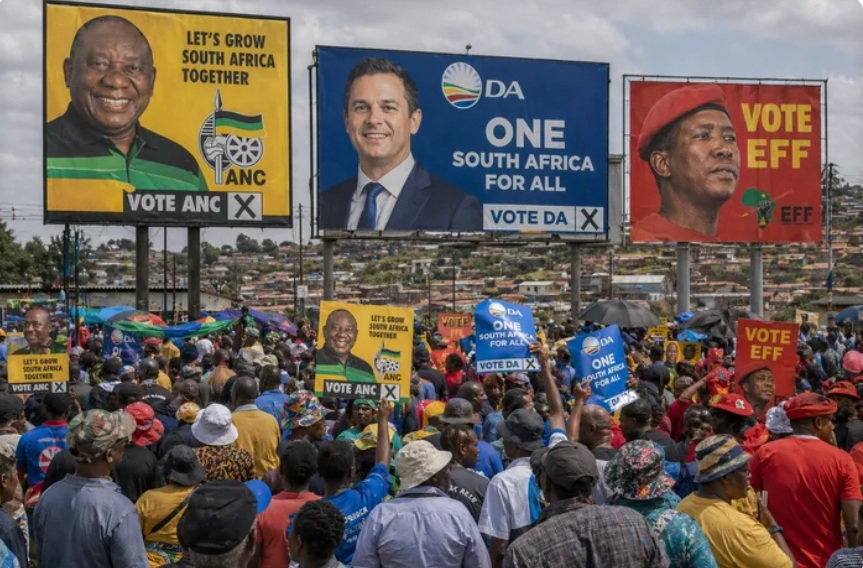
FREEDOM Month couldn’t have come at a more convenient time. Right on cue — just as election season begins to heat up — we are reminded of 27 April 1994, of democracy, and of the power of our vote.
Yet, as South Africa is celebrating freedom, many of its people are still desperately searching for it. For millions, freedom has become something strenuously negotiated in the realms of inequality, injustice, and survival.
As we conclude Freedom Month — we look forward to the revered long weekend, culminating in Freedom Day. This is a prime opportunity to really crack down on our progress as a nation, particularly considering the upcoming elections.
As we draw deeper into our election season, our government has been consistently churning out the same-old line: “27 April marks not only the birth of a democratic nation but also stands as a testament to South Africans' unwavering commitment to justice, equality, and human dignity, in the hope of building a better, more inclusive future for all.”
This is, honestly, a hard pill to swallow. In fact, many would argue that our post-apartheid “democracy” is an absolute fallacy — the exact opposite of the reality of modern-day South Africans.
Today, our nation is severely ravaged by injustice. Human dignity is haphazardly sacrificed every single day. And of course, ours is still — over three decades into democracy — the most unequal society in the world.
But the government was right about one thing: “Freedom Day is not simply a date in history books. It is a continuous and ever-changing process that is prevalent within the day-to-day struggles for justice and equality…”
And this is something many South Africans have failed to understand: Freedom wasn’t just a moment frozen in history. Freedom is a continuous mission. It’s ever-evolving. It is shaped by the needs and conditions of South Africans today — their challenges, geopolitical dynamics, economic conditions, and lived realities. All of these shape how freedom is experienced and defined. And that is why it’s so important — especially in our nation — to know what freedom instinctively and subjectively means to you.
Because the truth is this: not many South Africans understand what freedom means. Not really. And this is alarming, as we near another election.
In fact, elections in our nation have been reduced to popularity contests amongst leading political parties. Everyone seems to focus on who to vote for, instead of why they’re voting in the ways that we are.
The government claims to “believe that true freedom is incomplete without justice and reconciliation in the world.” They claim to “support those who are still fighting for their freedom — whether it be economic, social, political, environmental, or psychological.” But we all know this is a bunch of poppycock. This is not the reality we face.
Furthermore, in the public eye, we always maintain a moral high ground. From being the first nation in the world to chastise the Israeli genocide of Palestinians in Gaza to our calls for the United Nations to reassert itself in global affairs, we boldly call for reform in global governance institutions — yet fail to wrangle the perverse corruption in our own governance.
Yes, there are conflicts in the world. There are wars happening in our neighbouring nations. And yes, these conflicts affect us, often whether we like it or not. But they are not what Freedom Day is about. Freedom Day is about us — our nation, our people. It has little to do with geopolitical tensions and more to do with South Africans’ freedoms in our own homes, streets, schools, workplaces, and public institutions.
This is about the persistently poor service delivery we contend with across the nation, on a weekly or daily basis. This is about the consistent challenges with corruption — stealing the funds meant to maintain our neighbourhoods, schools, hospitals, roads, and so much more. This is about the same bubblehead figures being paraded around, spewing the same empty promises every election season while lambasting one another for what the other has “not” been doing.
And this is the issue with our political climate. It still seems rooted in that apartheid-era tendency of disinformation, blame-shifting, and blatant competition for power. It’s purely focused on presentation rather than practical transformation. Hence, this is a prime opportunity to re-educate citizens on the value of your vote — particularly in a nation where unimaginable deaths were suffered just to secure the right and privilege of voting.
In that sense, our vote should be amongst the most sacred processes we undergo in this fragile democracy. Yet now more than ever, despite our so-called Government of National Unity, election season is still just an array of parties putting on a show.
This is where we are now: a democracy that demands participation, but rarely demands understanding. And if we are not careful — if we keep voting without asking what freedom actually means in practice — then we will keep electing versions of the same disappointment. What’s clear is that it is not democracy that is broken — it is intention. And that breakdown is beginning to define us more than anything else, even our hard won “freedom”.
Yes, we can go back to history. However, freedom is not sustained by memory alone, but also by meaning. We can even track the exact progress of the “empty promises” that these parties regurgitate every election season. But if we’re not voting with knowledge and intention, we’re in deep trouble — or as the youth say, we are absolutely “cooked.”
* Tswelopele Makoe is a gender and social justice activist and editor at Global South Media Network. She is a researcher, columnist, and an Andrew W Mellon scholar at the Desmond Tutu Centre for Religion and Social Justice, UWC.
** The views expressed here do not reflect those of the Sunday Independent, IOL, or Independent Media.
This article was originally posted by IOL